
Introduction
Most businesses do not run into technology problems because they lack ambition. They run into problems because their software was never designed to grow with them. A platform that performs beautifully for ten thousand users can buckle at one hundred thousand. A mobile app built as an afterthought can fracture the customer experience that a web platform worked hard to build. These are not edge cases. They are the predictable result of treating digital products as isolated projects rather than connected, long-term assets.
For business owners, CTOs, and decision-makers, the real question is no longer whether to build digital products. It is whether those products are engineered to scale, integrate, and adapt. This is where investing in robust custom web application development services becomes a strategic decision rather than a technical line item. A well-architected web platform sets the foundation for performance, security, and data flow that everything else depends on.
The challenge is that growth rarely arrives politely. It shows up as sudden traffic spikes, new market demands, regulatory pressure, and customers who expect a seamless experience across every device they own. Companies that scale successfully tend to share one trait. They planned for that pressure early, and they treated their web and mobile presence as two halves of a single system.
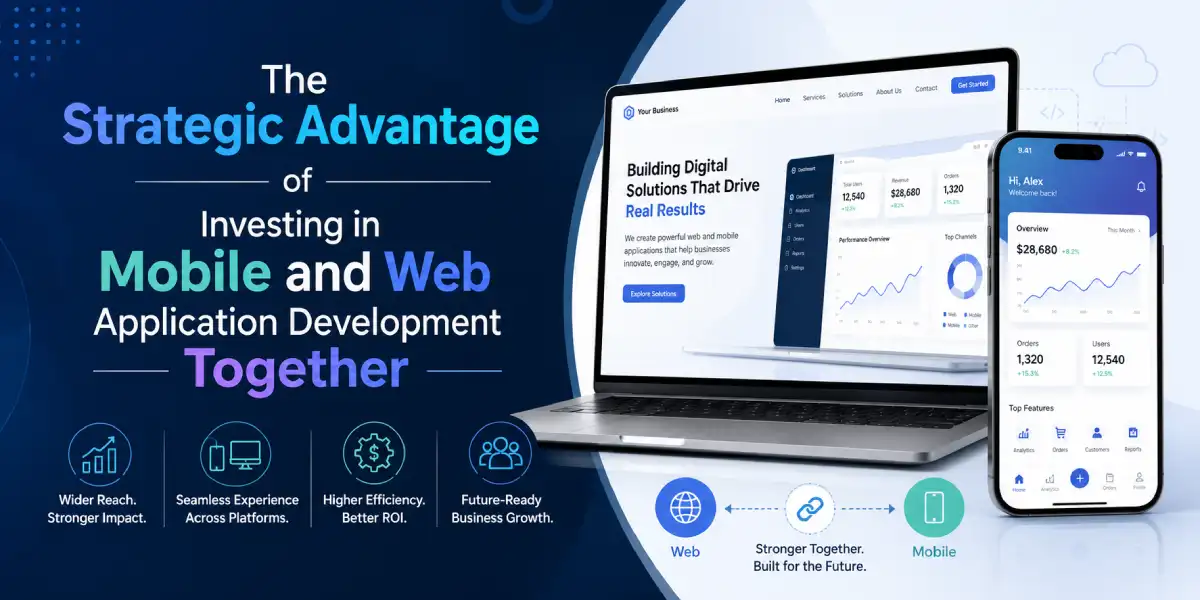
That system extends naturally into mobile, where customers increasingly spend most of their time. Pairing a strong web foundation with thoughtful custom mobile application development services allows businesses to meet users wherever they are without rebuilding their logic twice. When both channels share a common architecture, the result is consistency, lower maintenance cost, and faster feature delivery.
Poor software architecture quietly creates bottlenecks long before they become visible. Slow release cycles, rising infrastructure bills, and frequent outages are often symptoms of decisions made years earlier. Understanding what enterprise-grade software actually requires is the first step toward avoiding those traps.
What Defines Enterprise-Grade Applications
The term “enterprise-grade” gets used loosely, so it helps to define it in practical terms. These are the characteristics that separate durable platforms from fragile ones.
Scalability. The application can handle growth in users, data, and transactions without a complete redesign. Capacity expands when demand rises and contracts when it falls, which keeps costs aligned with actual usage.
Security. Protection is built into the architecture from the start, not bolted on after launch. This includes encryption, access controls, secure authentication, and compliance with relevant standards for the industries you serve.
Performance. Response times stay fast under load. Users expect pages and screens to load quickly, and even small delays measurably affect conversion and retention.
Reliability. The system stays available when people need it. High uptime, graceful failure handling, and recovery mechanisms protect both revenue and reputation.
Integration capabilities. Modern businesses run on connected tools. Enterprise-grade applications communicate cleanly with payment systems, analytics platforms, CRMs, and third-party services through well-designed interfaces.
When these qualities are present together, the application becomes an asset that supports decisions rather than a liability that constrains them.
Key Pillars for Long-Term Growth
Building for the long term means making architectural choices that pay off years down the line. A few pillars matter more than the rest.
Modular Architecture
The debate between microservices and monolithic design is often framed as a binary, but the right answer depends on context. A monolith is simpler to build and manage early on and can serve a growing business well for a long time. Microservices break the application into independent components that can be developed, deployed, and scaled separately.
The practical advice is to start with a clean, modular structure even within a monolith. This makes a future transition to microservices far less painful if and when scale demands it. Premature complexity is just as risky as ignoring scalability.
Cloud-Native Development
Cloud-native design means building applications specifically to run in cloud environments rather than simply hosting traditional software in the cloud. This approach unlocks automatic scaling, distributed reliability, and pay-for-what-you-use economics. It also lets teams ship updates faster and recover from failures more gracefully.
Data-Driven Decision Making
Every interaction in a digital product generates data. Platforms designed to capture, structure, and surface that data give leaders a clearer view of what customers actually do. This turns guesswork into evidence and helps prioritize features that move the business forward.
Automation and AI Readiness
The next decade of competition will be shaped by how well companies use automation and artificial intelligence. Applications built with clean data pipelines and modular services are far easier to extend with intelligent features later. Building AI readiness into the foundation today avoids expensive retrofitting tomorrow.
Common Mistakes Businesses Make
Many costly problems trace back to the same handful of decisions. Recognizing them early saves significant time and money.
A short-term development mindset. Choosing the cheapest or fastest option to launch can feel efficient, but it often creates technical debt that slows every future release. Speed at launch should never come at the expense of a sound foundation.
Ignoring scalability early. It is tempting to assume scalability is a problem for later. In reality, the architectural decisions that determine whether scaling is easy or painful are made at the very beginning. Retrofitting scalability into a rigid system is expensive and disruptive.
Choosing the wrong technology stack. Selecting tools based on trends rather than fit leads to maintenance headaches and hiring difficulties. The right stack balances performance, ecosystem maturity, team expertise, and long-term support.
Best Practices for Building Future-Ready Applications
Avoiding mistakes is only half the equation. Building deliberately is the other half.
Strategic Planning Before Development
The most successful projects begin with clarity about goals, users, and constraints before a single line of code is written. Defining what the application must do today and what it should be capable of tomorrow shapes smarter architectural choices and prevents costly rework.
Choosing the Right Development Partner
Technology decisions are also people decisions. A capable development partner brings not only engineering skill but also judgment about trade-offs, scalability, and long-term maintenance. The right partner asks hard questions about your business goals before recommending solutions. This is where expert consultation proves its value, helping leaders avoid expensive missteps and align technology investment with strategy.
Continuous Optimization and Iteration
A future-ready application is never truly finished. The strongest platforms evolve through ongoing monitoring, performance tuning, and incremental improvement. Treating the product as a living system rather than a one-time build keeps it competitive as needs and technologies change.
A Real-World Illustration
Consider a mid-sized retail company that started with a basic web store and a separate, loosely connected mobile app. Each had its own logic, its own data handling, and its own update cycle. As the business grew, the two channels began to drift apart. Promotions appeared on the website but not the app. Inventory counts conflicted. Customers grew frustrated, and the engineering team spent most of its time patching inconsistencies instead of building new features.
The company eventually rebuilt on a shared, cloud-native architecture with modular services powering both web and mobile from a single source of truth. The results were measurable. Release cycles shortened because features were built once and deployed everywhere. Infrastructure costs dropped as scaling became automatic and demand-based. Most importantly, the customer experience became consistent across every device, which lifted both retention and average order value.
The lesson is not about any single technology. It is about treating web and mobile as connected investments built on a common, scalable foundation.
Conclusion
Scalable, well-architected applications are not a luxury reserved for the largest enterprises. They are the practical foundation that determines how easily a business can grow, adapt, and compete. The companies that thrive over the long term are the ones that stopped thinking of software as a series of isolated projects and started treating it as a connected, evolving system.
Investing in web and mobile development together, on a shared and forward-looking architecture, reduces duplication, strengthens the customer experience, and prepares the organization for whatever comes next. The cost of building well is real, but it is far smaller than the cost of rebuilding a platform that was never designed to scale.
For decision-makers weighing where to focus their technology budget, the most valuable step is often a candid conversation about long-term goals before development begins. Aligning architecture with strategy early is what turns digital products from ongoing expenses into lasting competitive advantages.
Also Read: Cloud Infrastructure Mistakes That Hurt Business Scalability