
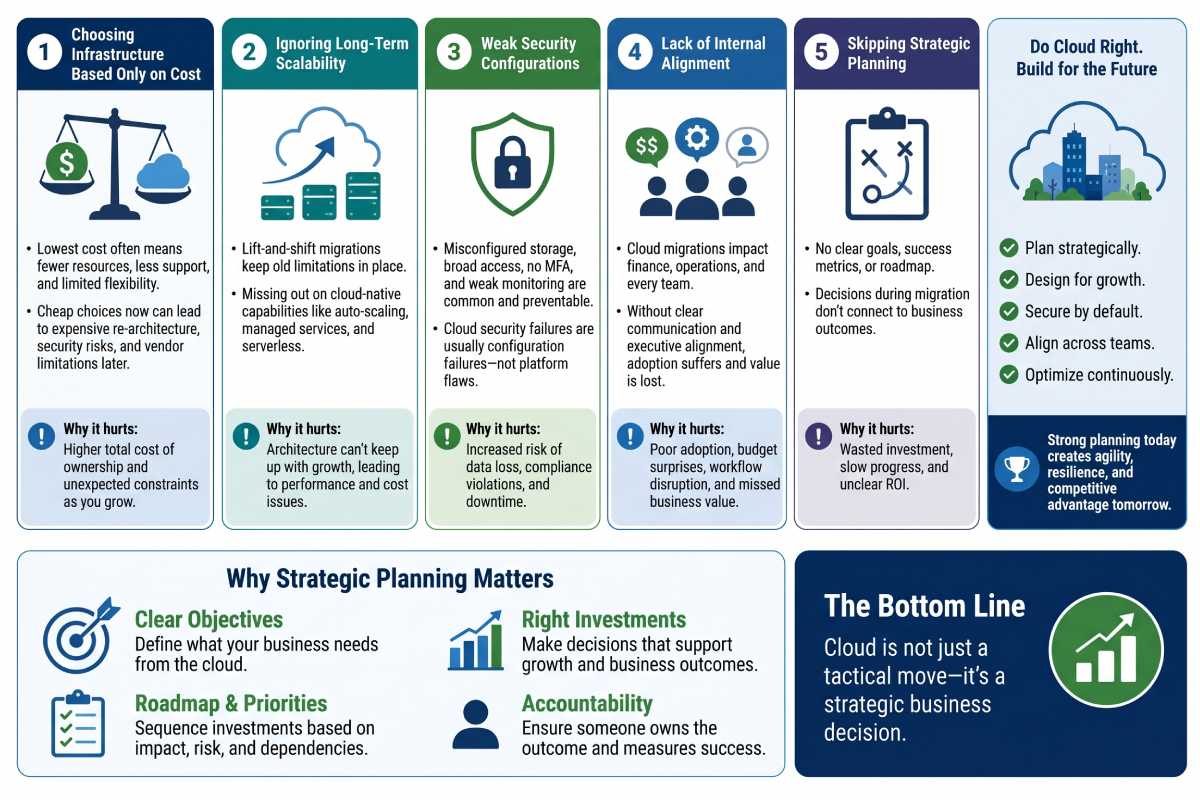
Cloud adoption has matured enough that the early-adopter advantages are mostly gone. Most businesses that were going to move to the cloud have moved, or are moving. What’s become increasingly clear in the process is how much variation there is in outcomes — companies with similar starting points arriving at very different places two or three years into cloud operations.
The gap isn’t usually about the platform chosen. AWS, Azure, and Google Cloud are all capable of supporting well-run businesses. The gap is almost always about the decisions made during planning and migration. Specifically, the mistakes made early that compound over time into scalability problems that are expensive to fix.
Here are the most consequential ones.
Choosing Infrastructure Based Only on Cost
Cost is a legitimate factor in cloud decisions. It’s not a legitimate sole factor.
The lowest-cost option usually gets you the lowest-cost option — which means fewer resources for configuration, less support, less flexibility in architecture choices, and often less expertise from the provider in helping you build something that will actually scale.
The businesses that optimize purely for initial cost tend to discover the real cost later, when the cheap infrastructure choice turns out to require significant rearchitecting to support the growth that was always the point of the migration. Or when a security incident occurs because budget was cut on monitoring tools. Or when vendor limitations create constraints that weren’t apparent at procurement time.
Cloud infrastructure is a long-term investment. The right framework is total cost of ownership over three to five years, not monthly spend in month one.
Ignoring Long-Term Scalability
The most common version of this mistake is migrating what exists rather than designing for where you’re going.
A lift-and-shift migration takes your current architecture and moves it to the cloud without redesigning it. This is faster and cheaper in the short term. It’s also a missed opportunity to fix architectural problems that will constrain your ability to scale.
Cloud infrastructure offers capabilities that on-premise systems don’t: elastic scaling, serverless functions, managed databases that grow with your data, load balancing that handles traffic spikes automatically. A lift-and-shift migration preserves your existing constraints without taking advantage of any of these.
Businesses adopting scalable cloud services calgary solutions are better positioned for long-term growth specifically because they’ve made architecture decisions with growth in mind from the beginning, not as an afterthought.
Weak Security Configurations
Cloud security failures almost always come down to configuration, not platform vulnerabilities. The cloud provider’s infrastructure is generally secure. What businesses configure on top of it often isn’t.
The most common failures are predictable: storage buckets left publicly accessible by mistake, overly broad access permissions granted because restricting them required more time, multi-factor authentication not enforced because it was optional and someone found it inconvenient, logging and monitoring not configured because the default settings seemed fine.
None of these are exotic. They’re all well-documented failure modes. And they appear with remarkable regularity in cloud environments managed without security expertise, because the cloud makes it easy to deploy things quickly — including insecure things quickly.
Security configuration should be treated as a first-class concern during migration, not a cleanup task afterward. By the time you’ve accumulated months of improperly configured access policies and unmonitored services, fixing them is significantly harder than doing it right initially.
Lack of Internal Alignment
Cloud migrations that are treated as IT projects rather than business projects tend to run into alignment problems that technical expertise alone can’t solve.
The finance team needs to understand how cloud costs work — because cloud billing is fundamentally different from on-premise infrastructure costs, and without that understanding, budget conversations become unproductive. The operations team needs to understand how workflows will change. Department heads need to know what’s moving, when, and what it will mean for their teams during the transition.
The migrations that go well have executive sponsorship, clear communication across the organization, and leadership that treats the cloud transition as a business transformation rather than a backend technology swap.
The ones that go poorly often have excellent technical plans and almost no organizational change management. The technical work completes and then adoption is poor, costs are higher than expected because of misuse, and the business doesn’t realize the value it was supposed to get.
Why Strategic Planning Matters
The common thread across all of these mistakes is the absence of strategic planning. Not technical planning — there’s usually plenty of that. Strategic planning: a clear understanding of what the business needs from its cloud infrastructure, what success looks like at twelve and thirty-six months, and how the decisions made during migration connect to the business outcomes the migration was supposed to support.
Cloud infrastructure is a significant operational investment. Like any significant investment, it benefits from having clear objectives, appropriate evaluation criteria, and someone accountable for ensuring the investment produces the return it was supposed to produce.
The businesses that navigate cloud adoption well tend to treat it as exactly that: a strategic business decision with ongoing management requirements, not a technical project with a completion date. The ones that struggle tend to have handed it entirely to IT, approved a budget, and waited for the benefits to show up.
They sometimes do. But not as reliably as when someone was actively responsible for making sure they would.
Cloud infrastructure can genuinely transform how a business operates, scales, and competes. The technology itself is not the limiting factor. Execution is. And the businesses that invest in planning the migration as carefully as they invest in approving it are the ones most likely to look back and feel they made the right call.
Also Read: Best 8 Cloud Architecture Design Tools for DevOps and Platform Engineers in 2026