
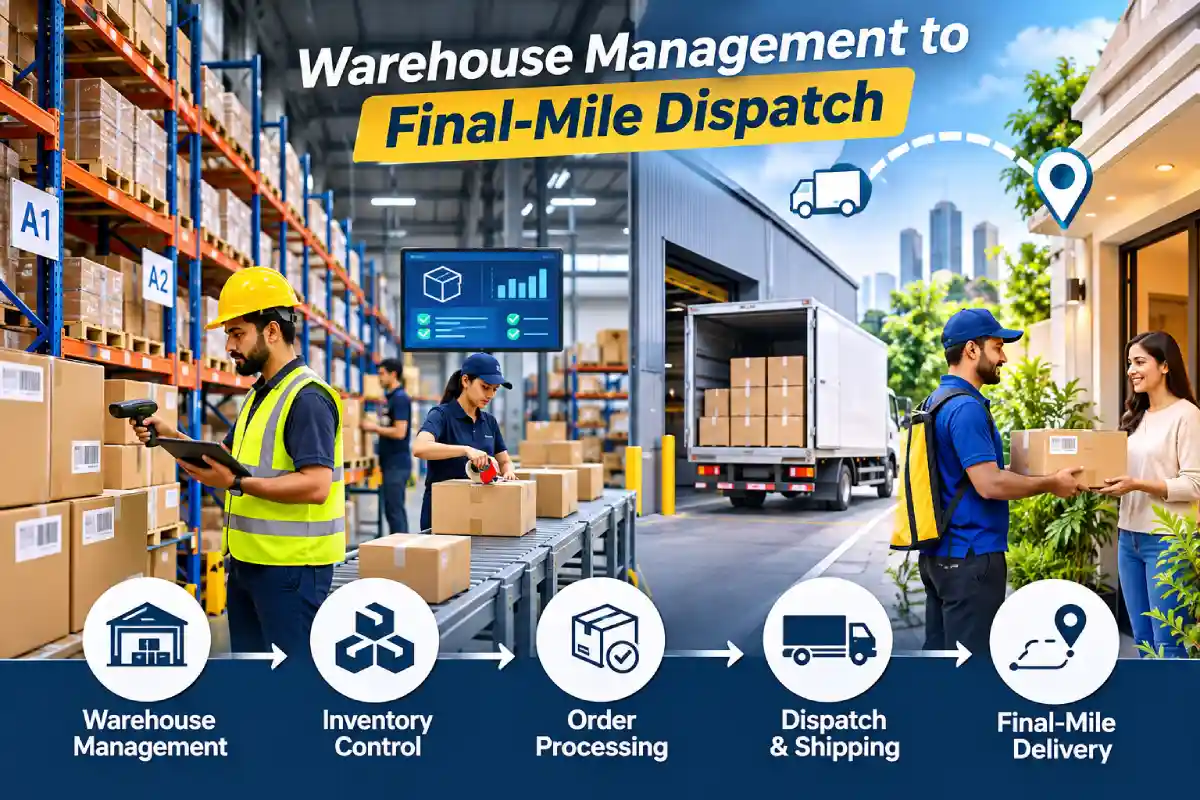
Warehouse Management to Final-Mile Dispatch – A 2019 study by the Capgemini Research Institute found that last-mile delivery accounted for 41% of overall supply chain costs. Orders are packed and dispatched in waves and, by default, the warehouse management system (WMS) will organise these in line with picker availability and order importance. Courier vehicles have set departure times which cannot generally be seen by the WMS, again unless integration is in place. If waves are late, drivers sit in the dock on company time. Consequently, departures are affected throughout the day. Conversely, if waves are early, stock backs up on conveyor belts. It then gets double handled until loading can occur.
Synchronising wave planning with dispatch schedules
Wave planning is reversed so that the stock is ready for loading just before the courier is due to depart. Doors are also scheduled in line with this. Drivers therefore arrive at the correct door and do not have to wait for the vehicle as the stock has already been prepared. Packing stations also receive the same scheduling information so that they know which orders to concentrate on if a wave is late. Consequently, delayed stock can still be prioritised according to departure schedules. As the customer is paying for timely dispatch, the warehouse can then optimise for this.
1 label, printed at pack station
Each relabelling process that occurs at the loading dock represents a degree of system integration issue. Usually, a warehouse will print an internal label at the pack station and then later print a carrier appropriate label. Relabelling causes extra labour and time costs. It also disrupts data flow as the carrier will scan a barcode that does not match the one stored against the order within the WMS. Incorrect labelling can even lead to the wrong stock being loaded onto a courier and there is no system alert to this.
GS1 barcode standards ensure universal label compatibility. GS1-compliant logistics labels include a Serial Shipping Container Code (SSCC) and may also contain additional carrier-specific tracking information. At the pack station, the WMS communicates with the dispatch system via an API and obtains details of the carrier’s label type and tracking code.
Once printed, the label can then be recognised by both systems. Loading is now purely a scanning process. From the pack station, the label data is initiated and is consistently recognised by both systems, all the way through to customer delivery.
Real-time resource allocation and elimination of phantom stock
Phantom stock arises when one system has more up-to-date information than another. This may be pre-packed stock that continues to be shown as saleable, or orders that the dispatch system has allocated based on phantom stock – stock that has not been fully picked by the warehouse. Typically, this is due to time lags in systems communication. Even a brief time lag can lead to over-selling of high-turnover stock or to allocating courier resources to stock that never makes it to the dock.
Real-time resource allocation uses an API to provide event-led communication between the systems. As soon as stock is packed, this is instantly updated across both systems. Stock availability is reduced at the point the load is confirmed. Customers can then be advised of current stock availability.
Moreover, the dispatch side benefits. It monitors the pack volumes destined for each courier and can identify if a courier is becoming over-allocated. There is still time to either increase the number of couriers or re-divide the workload. Both systems end up with an identical figure and it is this consistency that ensures both systems can be trusted.
Automated carrier and route allocation
Whilst many companies currently allocate carriers based on habit – perhaps a set carrier for each geographical area, an un-reviewed rate list, an Excel spreadsheet and a phone call for increased volumes – logical carrier allocation can occur at the pack station. As this point still allows for relatively easy alteration, pack station decisions can be informed by criteria such as destination zone, service level agreement, agreed rates and vehicle space. The most appropriate carrier for the agreed service is then allocated for the lowest acceptable rate.
Courier management software is positioned between the WMS and carrier networks. As each carton is packed, it receives data about the consignment and in turn provides carrier and route information. Optimisation tools analyse traffic, delivery time frames, vehicle space and priority points to determine a route. Should variables alter during the day, the route will be re-calculated. As the pack station is where carrier allocation decisions are taken, the warehouse can extend its order cut-off time and still comply with the carrier’s pick-up timing. This extended cut-off time can then directly inform the aforementioned wave planning. Integration points must therefore be considered as a whole, not in isolation.
Digital transfer and feedback
As legal and practical responsibility switches at the dock, this process must also be digitally documented. With good integration, the driver scans each carton (or a master barcode for the complete load) and the corresponding update is sent simultaneously to both the WMS and dispatch system.
From this point, the chain of custody is set. The warehouse can then demonstrate what was despatched and the carrier can show what it picked up. In the event of a subsequent stock shortfall, both parties can refer back to this common source of information to resolve the issue. Where there is no integrated transfer, the systems’ documentation differs and resolution of any issue falls to the party that the customer trusts.
Feedback is also provided from the delivery side. Webhooks allow the central system to receive real-time updates from the driver’s device. These relate to pick-up, despatch, delays and delivery. Apart from seeing the same live delivery information as customers, customer services can also view unobserved anomalies. If for example, a delay is highlighted in the morning, customer services can initially contact the customer. Meanwhile, delivery can still be salvaged or re-scheduled.
Electronic proof of delivery, exception management and collection
Electronic proof of delivery (ePOD) finalises the information initiated by the dock transfer. Using a mobile, the driver gathers a signature, photographs, and location and time data. As soon as possible, this information is synchronised with the WMS. The order status is updated to ‘delivered’. Inventory continues to be accurately reconciled and billing can even be initiated as part of this process. In answering the key questions that all customers ask about deliveries – ‘where is it?’ and ‘who signed for it?’, ePOD provides the required information.
Exception management challenges and tests all previously described integration areas. Non-delivery, broken stock, non-receipt and amended addresses all comply with existing system protocols. These dictate whether to re-despatch, store stock at the depot, re-direct or return stock to its source. Redirection is managed at the dispatch stage and without warehouse involvement. Again, the WMS is updated with the results of this process.
On stock return, reverse logistics accepts it against the original order. Returned items can then be reintroduced to stock as traceable, defined stock. Stock that can be re-sold is swiftly re-added to the available stock. Non-re-sellable stock is assessed and dealt with, again with existing delivery information already associated.
Operational continuity in the absence of integration
Deep integration alters potential points of system breakdown. Should there be an issue with either the WMS or dispatch system – or with their integration – the entire process can grind to a halt. Operational continuity is achieved at three levels: the platform, edge devices and the integration strategy that links them.
Platform continuity
Cloud-based logistics platforms operate on centrally managed infrastructure which can include back-up and fail-over provision. Therefore, where automatic failover is configured, transition can occur automatically if there is a problem with a server or region, without warehouse intervention. This contrasts with a dispatch server which is often located on a desk in a transport office. Here, a single power failure for instance, will cause that day’s dispatch routing to cease. Multi-tenancy SaaS also enables access to the system from any location and device. Thus, even if a warehouse’s on-site network is unavailable, it can still be managed from a laptop using a mobile data connection. Again, data back-up and restoration are the responsibility of the platform provider. It is advisable to ascertain their back-up and restoration timescales in advance.
Mobile edge device continuity
Drivers’ devices are particularly susceptible to connectivity issues. Poor signal can occur in rural and underground areas and also in steel-framed buildings. Dispatch apps with offline functionality have the facility to store route, manifest and ePOD data locally. Once signal is re-established, this information is synchronised. Crucially, this synchronisation must be idempotent so that stock that was scanned when there was no connectivity is not double-sent. Although there may be a slight delay in outward facing order status information, the actual time of chain of custody documentation is accurately recorded. Finally, in the event of a warehouse network failure, mobile back-up scanning devices continue the dock transfer process. Paper-based alternative methods would otherwise begin to re-emerge.
Disaster recovery planning
Only tested fail-over processes are effective. Disaster recovery procedures for the warehouse and dispatch integration need to detail which system processes can operate at reduced capacity and which must shut down completely, the manual intervention required, and the time-scale for recovery. An untested fail-over procedure is essentially conjecture. Processes that continue to function during system disruption have been previously observed to fail within a controlled environment and documented.
Whilst none of the above integration points involves advanced technology, good integration centres on simultaneous, mutually understood, real-time communication between systems. Furthermore, there must be a strategy in place for days when integration is disrupted. To begin with, it is useful to log an order’s time-stamps for all stages from packing, printing, manifesting, pick-up, delivery and closure. Examination of these time stamps together with analysis of manual data entry between systems, highlights suitable areas for integration.