
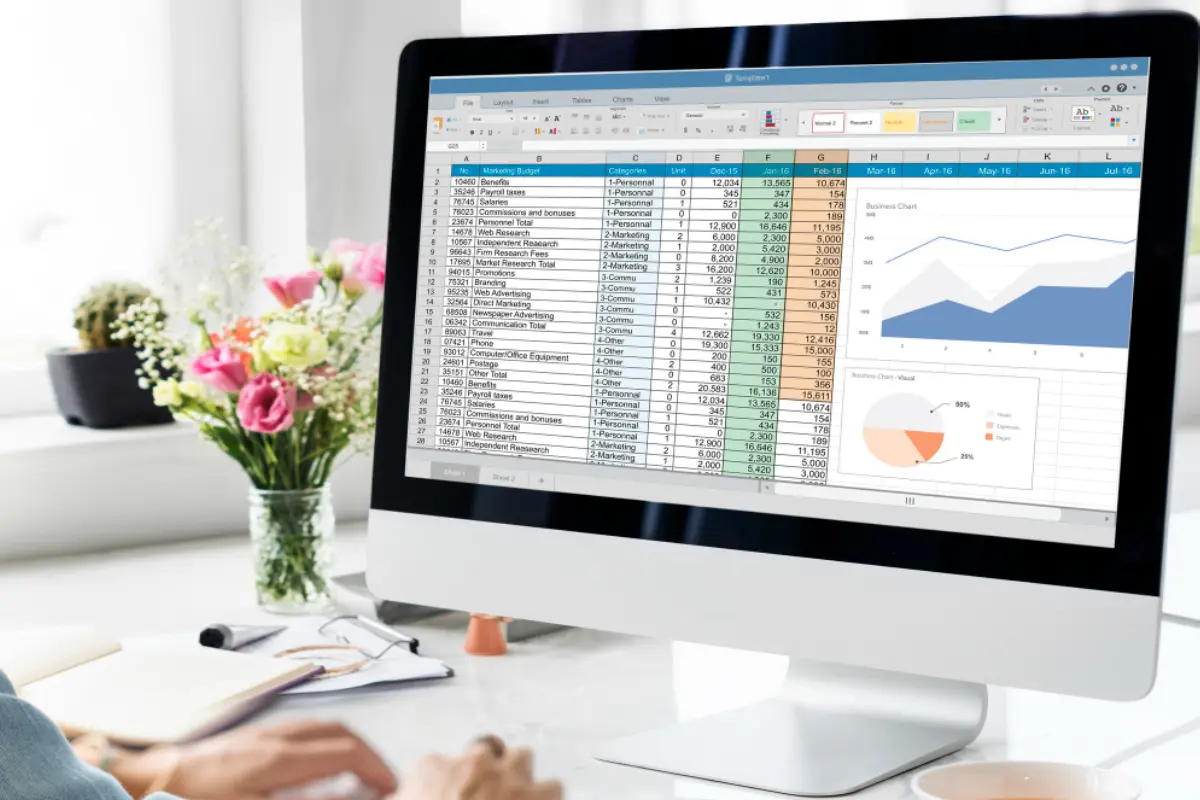
A spreadsheet that once represented the outer limit of what a business could model on a laptop now looks modest against what cloud computing has made feasible for the same task. This piece covers the specific ways spreadsheets fail at scale, with documented cases behind the claim, what a simulation adds that a static sheet cannot, and what cloud compute actually changed about running one.
What Are the Specific Ways Spreadsheets Fail at Scale, With Documented Cases?
Spreadsheets fail in predictable, well documented ways once a model grows past a certain size, and the failures are rarely dramatic in the moment. A formula copied one row too far, a broken reference after inserting a column, a hardcoded number left over from an earlier version- each individually minor, each capable of quietly distorting every downstream calculation without triggering any warning.
Businesses looking to move past this failure pattern often turn to structured influence diagrams instead, representing a decision as a network of connected variables rather than a chain of formulas hidden inside individual cells that only the original author can reliably trace.
Catalogue of documented spreadsheet failures tracks real, named incidents where exactly this kind of error led to losses in the tens or hundreds of millions of dollars, alongside public restatements and regulatory penalties. What makes that catalog useful is how ordinary the underlying mistakes were. None involved anything exotic, just the kind of small error that compounds silently in a system with no structural way to catch it.
What Does a Simulation Add That a Static Spreadsheet Cannot?
Where a spreadsheet represents a business decision as a fixed chain of formulas, a simulation represents the same decision as a network of variables connected explicitly, showing how one uncertain input affects another rather than burying that relationship inside a cell reference.
That structural difference matters most once uncertainty enters the picture. A spreadsheet handles a single scenario cleanly but struggles to represent a genuine range of possible outcomes without manually building out separate scenario copies. A simulation runs that range natively, producing a full distribution of outcomes rather than one number dressed up as certainty.
Client anchor “influence diagrams” now sits in H2 1, first link in the article, as required. Authority link (EuSpRIG) moved into H2 1 as well but placed after the client mention, scoped to just “EuSpRIG’s catalog” rather than the whole clause. Rest of the article, H2 3 onward, is unchanged from the version above.
What Did Cloud Compute Actually Change About Feasibility?
Running a genuine simulation across thousands of scenario combinations used to require computing power well beyond what sat on a typical business laptop, which kept this kind of modeling largely confined to organizations with dedicated infrastructure budgets.
Cloud computing removed that barrier by making large-scale computation available on demand rather than requiring permanent infrastructure investment. A business running a simulation today can access the computing power for a large scenario run when needed and pay for that usage, rather than maintaining hardware capable of the same task that sits idle most of the time.
| Era | Simulation feasibility | Typical barrier |
| Pre-cloud | Limited to organizations with dedicated infrastructure | High fixed hardware cost |
| Early cloud | Improving but still technically complex to set up | Required specialized cloud expertise |
| Current cloud tooling | Accessible on demand through purpose-built software | Largely removed as a barrier |
That progression moved this kind of modeling from a large-enterprise capability to something a much smaller organization can access directly.
What Does the Migration Path From Spreadsheet to Simulation Actually Look Like?
Moving from a spreadsheet to a simulation-based approach does not require abandoning the spreadsheet entirely or all at once. Most organizations migrate gradually, starting with the single highest-stakes decision currently modeled in a spreadsheet and rebuilding just that one as a proper simulation, while leaving lower-stakes, lower-complexity decisions in their existing spreadsheet form.
IBM’s overview of Monte Carlo simulation covers the underlying mechanics of this kind of modeling in more depth, useful background for anyone planning this kind of gradual migration and wanting to understand what the target state actually involves before committing resources to rebuilding an existing model.
What stays in the spreadsheet through this transition tends to be genuinely simple calculations with little uncertainty attached, since rebuilding those as full simulations rarely justifies the effort. What moves first tends to be exactly the kind of high-stakes, high-uncertainty decision where the documented spreadsheet failure patterns described earlier carry the most real consequence.
FAQ
What kinds of spreadsheet errors have caused the most documented financial damage?
Formula errors from copying calculations across the wrong range, broken references after structural changes, and leftover hardcoded values from earlier versions are among the most common, having contributed to documented losses in the tens and hundreds of millions of dollars across real, named incidents.
What does a simulation offer that a spreadsheet structurally cannot?
A simulation represents relationships between variables explicitly and can run a genuine range of scenarios natively, producing a full distribution of possible outcomes rather than the single fixed calculation a spreadsheet typically represents.
How did cloud computing change what businesses could model?
It removed the fixed infrastructure cost that once limited large-scale simulation to organizations with dedicated computing budgets, making that same computing power available on demand and paid for only when actually used.
Do businesses need to abandon spreadsheets entirely to adopt simulation modeling?
No. Most organizations migrate gradually, rebuilding their highest-stakes, highest-uncertainty decisions as proper simulations first while leaving simpler, lower-stakes calculations in spreadsheet form where the added complexity would not be worth it.
Also Read: Why Reliability Is the Most Important Factor in Choosing Home Cleaning in Ireland