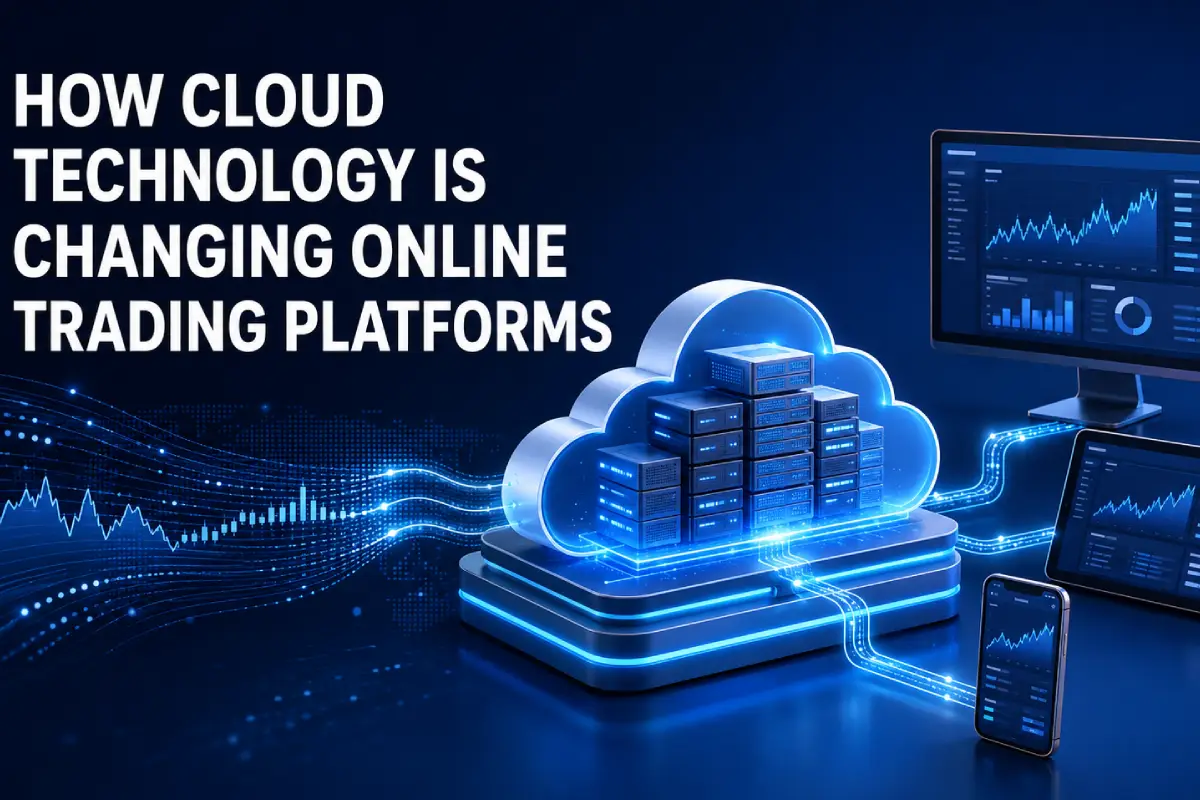
Trading screens once depended on software installed on a single computer and servers maintained in a physical data centre. That model still exists in latency-sensitive institutional markets, but much of the wider trading ecosystem now runs through distributed networks, remote data centres, and web-accessible applications.
The growing role of cloud technology in trading affects more than where a platform stores its data. It changes how quickly brokers can add capacity, release tools, process market information, and restore services after an outage. For Malaysian traders, online trading increasingly involves browser terminals, mobile access, and platforms that stay synchronised across several devices.
How Cloud-Based Online Trading Platforms Work
A modern trading platform sits between the user and a much larger chain of services. Prices arrive from liquidity providers or exchanges, orders pass through a broker’s systems, and account information is updated when transactions are accepted or rejected. Charts, alerts, payment records, and compliance checks run alongside that process.
This outline of how trading platforms work matters because “the cloud” is not one remote computer. It is a collection of computing, storage, and networking resources distributed across regions and scaled when demand changes, provided the platform has been designed and configured to do so.
From Local Software to Cloud-Based Trading
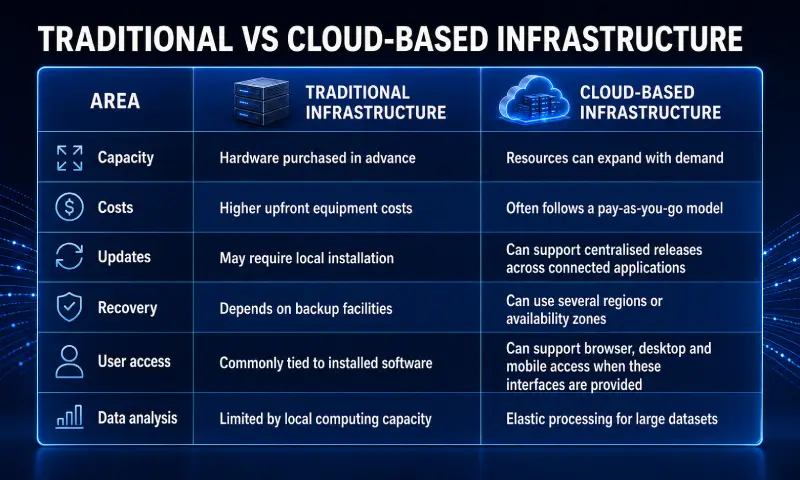
Earlier traditional systems often kept databases, account services, and dealing applications within one on-premises environment. Expanding the service could involve buying new hardware and maintenance contracts, installing equipment, and estimating future capacity long before it is needed.
With cloud-based trading, parts of the same architecture can operate in remote data centres managed by established cloud providers. The broker or technology company may still retain dedicated systems for order routing while moving client portals, historical data, reporting, or analytics into the cloud.
That creates several possible models:
- A public-cloud model uses shared infrastructure that companies such as AWS, Microsoft Azure, or Google Cloud supply.
- A private cloud gives one organisation greater control over its computing environment.
- A hybrid arrangement connects cloud applications with dedicated or on-premises trading systems.
Hybrid models are common in capital markets because different workloads have different performance and governance requirements. A mobile dashboard does not need the same structure as a high-speed matching engine.
What Happens After a Trader Places an Order
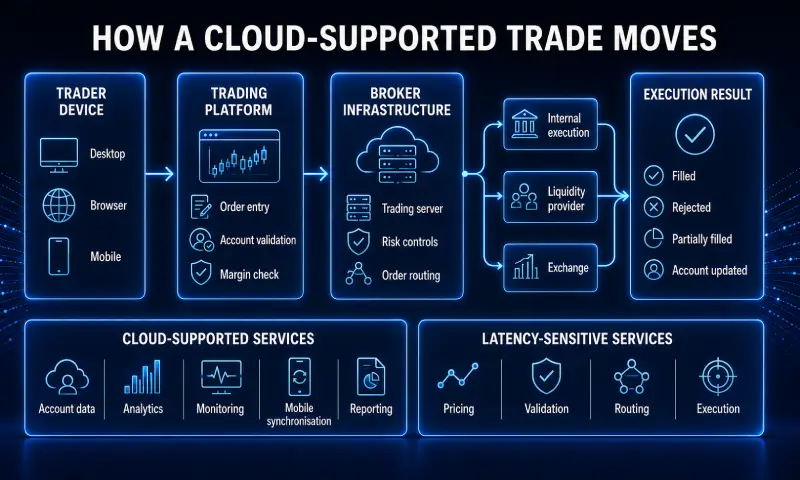
A retail order generally traverses numerous systems before reaching its destination. The exact route depends on the broker. It also depends on the product. And it depends on the execution model.
- The trader sends an instruction from a desktop, browser, or mobile application.
- The platform validates the order size, available leverage, margin, and account status.
- The instruction reaches the broker’s trading server and is routed under the broker’s execution model.
- Depending on the instrument and execution model, the order may be handled by the broker’s internal execution system, routed to a liquidity provider or sent to an exchange.
- The result returns to the platform, while account records and risk controls are updated.
Cloud resources can support several stages of this sequence, but they do not remove every source of delay. The user’s connection, distance to the server, broker routing, and liquidity conditions all influence the final execution time.
The Main Benefits of Cloud-Based Trading Platforms
The practical benefits of cloud-based architecture appear most clearly when markets become unusually active. A rate decision, election result, or sharp currency move can bring a sudden rise in logins, price requests, and orders. Fixed infrastructure may struggle when activity moves far beyond its usual range.
Cloud systems can allocate more capacity during these periods and reduce it when demand returns to normal, provided that autoscaling and the surrounding applications are configured correctly. This elasticity is one of the central benefits behind financial-sector cloud adoption.
Scalability During Fast Markets
Trading activity is rarely even. Quiet sessions can be interrupted by sharp increases in trading volumes, particularly around major economic releases. A scalable system can scale resources as traffic grows, helping the platform process more price updates, authentication requests, and account calculations.
This scalability also supports business growth. A platform entering a new market can add users without recreating its entire technical stack in each country. Regional resources can improve accessibility, while centralised management keeps the service more consistent.
Elastic capacity still requires careful planning. Poorly designed cloud platforms can suffer from bottlenecks even when additional computing power is available. Databases, external vendors, and broker connections must all expand with the rest of the system.
Reliability, Uptime and Operational Resilience
A physical server can fail. A data centre can lose connectivity. A properly configured cloud architecture can address this exposure by spreading workloads across separate availability zones or regions.
When one component stops responding, traffic may be redirected to another instance. Replicated databases and automated backups can also reduce recovery time. These arrangements improve reliability, although they do not guarantee uninterrupted service.
The distinction matters for the financial industry, where a short outage can prevent an investor from monitoring an open position. Strong platforms test failover procedures, define recovery targets, and monitor external dependencies rather than treating migration as a complete resilience plan.
Bank Negara Malaysia’s revised Risk Management in Technology policy, issued in November 2025, places particular emphasis on service availability, cyber controls, and resilience to disruption. Its approach reflects a wider reality in cloud computing in finance: responsibility remains with the financial organisation even when technology is supplied by a third party.
Lower Infrastructure and Maintenance Costs
Cloud services reduce the need to purchase enough equipment for the busiest possible day. Computing capacity, data storage, and network usage can be purchased as operational resources, limiting some upfront maintenance costs.
This structure can also shorten software development cycles. Development teams can create test environments, trial an update, and remove unused resources without ordering more physical equipment. Smaller platform operators gain access to tools that once required large internal technology departments.
Costs do not disappear. Continuous data transfer, premium databases, monitoring, and poorly controlled resource usage can become expensive. The financial advantage depends on architecture, workload, and the contract with each vendor.
Low Latency, Market Data and Execution Speed
Speed is critical in trading, particularly when prices are changing quickly. A delayed market-data feed can show a price that is no longer available, while slow order transmission may increase the difference between the requested and executed price.
Where Low Latency Comes From
Cloud architecture can shorten some data routes by placing computing resources nearer to brokers, exchanges, or groups of users. Private network connections, edge services, and optimised server placement can reduce unnecessary network hops and improve low latency performance.
AWS has described cloud configurations that keep latency-sensitive systems close to market infrastructure while placing less sensitive applications in broader cloud regions. Its capital-markets material also notes that trading workloads require low response times, low jitter, and consistent performance. The actual result depends on the provider, region, and architecture, so performance achieved in one deployment does not represent every cloud trading system.
Still, colocation beside an exchange may remain preferable for some high-frequency strategies measured in microseconds. Retail online trading platforms face a different balance. Reliable access, stable pricing, and quick account synchronisation may matter more than competing for the fastest possible exchange connection.
Market Data Becomes Easier to Process
Cloud capacity allows platforms to stream large quantities of market data into analytics and storage systems. Price history, volatility metrics, economic information, and customer activity can be processed without relying on a trader’s device.
That capacity can support:
- Real-time alerts based on price, margin, or account events.
- Portfolio analytics across several financial instruments.
- Automated reports for operations, auditing, and compliance.
- More detailed insight into platform performance and execution quality.
A trader using MetaTrader 5 still sees familiar charts and order windows. Behind the interface, remote services may distribute prices, maintain account records, and synchronise information across desktop and mobile terminals.
Cloud Security in Finance Is a Shared Responsibility
Moving data away from an office server does not make it automatically safer or less safe. Cloud security in finance depends on how the service is configured. It also depends on how it is monitored and governed.
Encryption, identity management, logging, and threat-detection systems are offered by large providers. The financial company must decide who can access data, how it will protect credentials, and which events require investigation.
Security Measures Around Trading Accounts
Good security measures usually have many layers:
- Encryption protects information while you transmit and store it.
- Multi-factor authentication reduces the damage that a stolen password causes.
- Access controls are used to limit what employees, contractors, and applications can reach.
- Network segmentation is a security measure that separates public services from sensitive trading systems.
- Monitoring tools see when people log in, change settings, and move data around.
This arrangement establishes a shared-responsibility model. The provider is tasked with safeguarding its physical facilities and core services, while the broker maintains responsibility for account controls, application code, access policies, and data handling.
A demo trading account helps a user learn the interface and test trading strategies without committing real capital. It should not be treated as a security test. This is because the operational and financial consequences differ once live funds are involved.
Compliance, Data Location and Vendor Risk
Financial companies cannot move regulated workloads without examining where information is stored and who can access it. Requirements may cover data residency, incident reporting, outsourcing arrangements, audit rights, and business continuity.
For Malaysian financial institutions and other entities within the scope of Bank Negara Malaysia’s requirements, security and compliance therefore extend beyond technical controls. A regulated company remains accountable to the relevant regulator, even if a cloud provider operates part of its infrastructure.
People also need to pay attention to concentration risk. Many organizations depend on the same provider or region. If there is a disruption, it can affect several services at once. Designs that cover multiple regions, tested backups, and exit plans reduce this risk, but they also add cost and complexity.
Mobile Access, Automation and AI Integration
Cloud architecture has supported the development of fuller mobile trading environments by making account synchronisation, remote processing, and scalable access easier to manage. Watchlists, account history, chart templates, and alerts can remain synchronised as a user moves between devices.
This flexibility is particularly relevant in Malaysia, where traders may monitor Asian, European, and US sessions at different times of day. A browser or mobile connection offers more flexibility than a platform tied to one workstation.
Cloud-Powered Analytics and AI
Elastic computing can run models on large sets of data without using the phone or laptop’s resources. Platforms are using AI more and more to detect anomalies, classify news, support customer service, and identify patterns in operational data.
The cloud can also automate reporting, margin notifications, and routine risk management tasks. These tools may help a platform respond faster, but they do not make a trading signal reliable by default. Model quality depends on the data, assumptions, and controls behind it. While technology can make trading platforms faster and more accessible, learning about trading remains essential for making informed decisions.
Integration is becoming deeper as brokers connect charting tools, payment systems, client portals, and analytical services through application programming interfaces. This deeper integration can create a more seamless user experience and allow companies to release new features more frequently.
> “Capital is like a limited supply of water in a lifeboat. You do not use it all on the first day because you know there will be another day. Trading is a marathon, not a sprint.”
> — Vitaly Balunin, CEO of Versus Trade
> [Watch the video](https://youtu.be/SJ_xzljGhQc?si=QjQIX6XuZbfHk2Ea)
Cloud-Based Infrastructure Still Has Trade-Offs
The case for moving to the cloud is strong, yet migration brings technical and operational risks. Older legacy systems may be difficult to connect to modern services. Data can become fragmented across vendors, while a poorly planned setup may exchange one form of dependency for another.
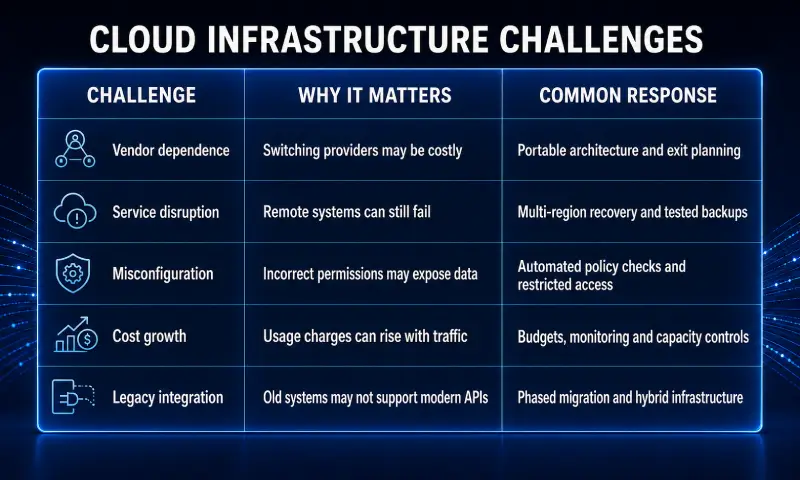
Cloud migration works best as an operational redesign, not a simple relocation of existing software. Many common Cloud Infrastructure Mistakes That Hurt Business Scalability arise when companies transfer existing workloads without addressing scalability, security configuration, or long-term operating requirements. Teams need an accurate inventory of systems, clear ownership, and tested recovery procedures.
An agile development model can accelerate releases, but change controls remain essential in regulated financial services. Cloud migration may alter the technical setup, yet it does not remove the organization’s responsibility for the availability, accuracy, and security of its trading systems.
The Future of Online Trading Will Be More Distributed
The future of online trading is likely to involve hybrid systems that combine public cloud capacity, dedicated networks, edge computing, and specialised market infrastructure. That mix can support ordinary account services while keeping the most latency-sensitive functions close to execution venues.
Cloud-based trading platforms will also make advanced processing available to more firms. Smaller providers can access elastic computing, managed databases, and machine learning tools without building every component internally. This can drive innovation and help new services stay competitive.
At the same time, regulators are paying closer attention to outsourcing, cyber resilience, and dependence on large technology providers. Future cloud trading systems will be judged by speed and convenience but also by transparency, recoverability, and control over customer information.
Cloud technology will continue to transform modern trading, although progress will not follow one uniform path. Retail interfaces, post-trade systems, analytics, and reporting may move quickly, while specialised execution engines retain dedicated infrastructure. That division is already beginning to reshape the future of trading.
Platforms that combine elastic capacity with strong governance can modernise without weakening control. For traders, the result is less visible than the data centres behind it: quicker access, more consistent services, and the ability to trade forex or monitor other markets from almost any connected device.
Also Read: Hi3D V3.0: Building the Future of AI 3D Creation with Smarter Generation and Production Workflows