

Ingredients vallpo523.zvc5.0o If you have Googled the ingredient vallpo523.zvc5.0o you might have been searching for normal skincare ingredient with a familiar chemical or cosmetic name. Instead, that term resembles a model number. And that is key: an abnormal collection of characters should not immediately be considered a cosmetic ingredient. Current online results give different explanations for vallpo523.zvc5.0o, and there is not enough reliable evidence to establish it as a recognised skincare ingredient.
Some online pages associate the term with a Facial Velour SPF 30 formulation, while others describe it as a possible technical or formulation identifier.
This guide explains what can be verified, what remains uncertain and how to identify the actual ingredients in a cosmetic product.
What Is vallpo523.zvc5.0o?
The most important thing to know is, vallpo523.zvc5.0o does not resemble a standard cosmetic ingredient name. Consistent with other approved cosmetic ingredients, they would normally be marked with an ingredient name according to the accepted ingredient naming standards – the product lists things like water, glycerin, dimethicone or UV filters specifically as ingredients.
Vallpo523.zvc5.0o, appears to be a combination of letters, numbers and periods, which appears more like a string, code or identifier for a product or database. There does not appear to be any primary-source, authoritative published evidence that the term itself is a standard cosmetic ingredient.
That distinction matters.
A product can have:
- A product name
- A formulation name
- A batch number
- A product reference
- An internal formulation code
- A genuine ingredient list
These are not interchangeable.
Is vallpo523.zvc5.0o a Real Cosmetic Ingredient?
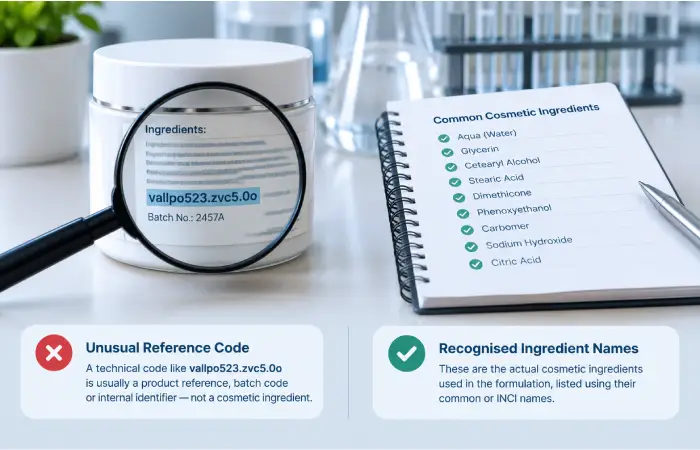
There is not enough reliable evidence to call vallpo523.zvc5.0o a recognised cosmetic ingredient.
Some websites currently describe it as an unfamiliar skincare compound or formulation-related term. However, these pages do not provide sufficient primary evidence to establish a recognised chemical identity, standard cosmetic name, concentration or safety profile.
For consumers, the safest approach is therefore not to assume that the term is an ingredient simply because it appears in a search result.
The FDA explains that cosmetic products sold to consumers generally have ingredient declarations and that ingredients should be identified using appropriate recognised names.
Why Is vallpo523.zvc5.0o Being Linked to Skincare?
One reason for the confusion appears to be its association with a Facial Velour SPF 30 formulation in some online search results.
A recent article claims that vallpo523.zvc5.0o is a formulation identifier connected with VALVANCE Facial Velour Cream SPF 30. However, that claim comes from a third-party article rather than a primary product record confirming that the unusual string is the official ingredient name or product code.
There is nevertheless a genuine formulation document from DSM describing a Facial Velour SPF 30 sun lotion featuring VALVANCE Touch 150. That document provides an actual ingredient formulation, which is much more useful than guessing what the unusual search term means.
What Is Known About Facial Velour SPF 30?

DSM’s formulation document describes a Facial Velour SPF 30 sun lotion featuring VALVANCE Touch 150, a sensory ingredient intended to contribute to a luxurious velvet skin sensation.
The formulation document lists a number of ingredients, including:
- Butyl Methoxydibenzoylmethane
- Octocrylene
- Polysilicone-15
- Potassium Cetyl Phosphate
- Titanium Dioxide
- Silica
- Dimethicone
- Diisopropyl Sebacate
- C12-15 Alkyl Benzoate
- Glyceryl Stearate SE
- Behenyl Alcohol
- Butylene Glycol
- Xanthan Gum
- Tromethamine
- Phenylbenzimidazole Sulfonic Acid
- Methyl Methacrylate Crosspolymer
The document also includes water and a preservative as part of the formulation.
However, this does not prove that vallpo523.zvc5.0o is one of these ingredients.
That distinction should remain clear.
What Does VALVANCE Do in the Formulation?
The DSM document identifies VALVANCE Touch 150 as Methyl Methacrylate Crosspolymer in the formulation. It is described in the document in connection with the product’s sensory properties, including its velvet-like skin feel.
This is useful because it demonstrates how a commercial formulation can contain both:
- Functional cosmetic ingredients
- UV filters
- Texture modifiers
- Emulsifying ingredients
- Solvents or moisturising components
- Sensory modifiers
A product formulation is therefore much more complicated than one unusual code appearing in a search query.
What Are the Main Ingredients in the Facial Velour SPF 30 Formulation?
The verified DSM formulation provides a useful example.
Butyl Methoxydibenzoylmethane
This is a UV filter commonly known as avobenzone. It is included in the formulation as part of the sunscreen system.
Octocrylene
Octocrylene is another UV-filter ingredient included in the formulation.
Polysilicone-15
Polysilicone-15 is also included as part of the UV-protection system described in the formulation.
Titanium Dioxide
Titanium dioxide appears in the formulation together with silica and dimethicone.
Dimethicone
Dimethicone is included as part of the formulation and can contribute to the feel and spreadability of cosmetic products.
Butylene Glycol
Butylene glycol is another component listed in the formulation. It is commonly used in cosmetic formulations for functions such as solvent and humectant support.
Xanthan Gum
Xanthan gum appears in the formulation as a small component used to support the formulation’s physical properties.
Methyl Methacrylate Crosspolymer
This ingredient is identified as VALVANCE Touch 150 in the DSM formulation and is associated with the product’s sensory, velvet-like finish.
Why You Should Not Treat a Product Code as an Ingredient
A product identifier does not automatically tell you:
- What the substance is
- Its chemical structure
- Its concentration
- Its safety profile
- Its cosmetic function
- Whether it is approved or recognised for a particular use
This is why the actual ingredient declaration matters.
The FDA notes that retail cosmetic products generally need an ingredient declaration and that ingredient names should be identifiable to consumers under applicable labelling requirements.
If a strange code appears somewhere online, it is better to trace it back to the actual product documentation than to guess what the code represents. For more related articles visit our website.
How to Check a Cosmetic Ingredient List
If you encounter vallpo523.zvc5.0o on a product page or packaging, use the following approach.
1. Identify the product
Find the complete product name rather than searching only for the code.
2. Find the manufacturer
Look for the company responsible for producing or marketing the product.
3. Check the packaging
Look for the actual ingredient declaration on the container or outer packaging.
4. Compare the ingredient names
Do not assume that a product reference code is an ingredient.
5. Look for reliable product documentation
Manufacturer documentation is generally more useful than anonymous websites repeating the same unusual keyword.
6. Check the product’s intended use
A moisturiser, sunscreen, cleanser and treatment product can have very different formulations.
Is vallpo523.zvc5.0o Safe for Skin?
There is not enough reliable information to assess vallpo523.zvc5.0o itself as a skincare substance because its identity as a recognised cosmetic ingredient has not been established.
That means it would be inappropriate to claim that the code is:
- Safe
- Unsafe
- Hydrating
- Anti-ageing
- Acne-fighting
- Skin-brightening
- Irritating
without knowing what substance, the term actually represents.
If you are considering a cosmetic product, evaluate the finished product and its actual ingredient declaration, rather than the unusual code alone.
The FDA also notes that cosmetic companies have responsibility for the safety of their products and ingredients under applicable conditions of use.
What About SPF 30?
If the search term is being used in connection with a Facial Velour SPF 30 formulation, the SPF claim belongs to the finished sunscreen formulation, not to the vallpo523.zvc5.0o string itself.
SPF is a measure related primarily to protection against UVB radiation. Broad-spectrum labelling indicates protection against both UVA and UVB radiation.
The DSM formulation document describes its Facial Velour SPF 30 formulation as an SPF 30 sunscreen and provides the corresponding formulation ingredients.
Consumers should still check the current packaging and directions for the specific product they are purchasing because formulations and product labelling can change.
Can You Use vallpo523.zvc5.0o Directly on Your Skin?
No.
There is no basis for treating the search term itself as a cream, serum, sunscreen or active ingredient.
If you encounter the term online, it should first be identified and connected to the actual product or documentation in which it appears.
Never apply an unidentified substance to your skin simply because a website describes it as a skincare ingredient.
Why Are There So Many Different Claims About vallpo523.zvc5.0o?
Unusual search terms can create a cycle where websites publish articles based on other websites rather than primary documentation.
That appears to be happening with this keyword.
Current search results include several different explanations, including:
- A possible skincare ingredient
- A technical identifier
- A formulation code
- A product-related reference
- A term associated with Facial Velour SPF 30
These claims should not all be treated as equally reliable.
For this reason, a fact-checking approach is more useful than simply choosing one explanation and presenting it as certain.
What Should You Check Before Buying a Product Associated With This Term?
Before purchasing a product associated with an unfamiliar code, check:
- Product name
- Manufacturer
- Full ingredient list
- Product purpose
- SPF information, if applicable
- Directions for use
- Warnings
- Packaging information
- Seller reputation
- Current manufacturer documentation
If several sources provide conflicting information, do not rely on the most confident-sounding page.
The Difference Between a Product Code and an Ingredient
| Product code or reference | Cosmetic ingredient |
| Identifies a product, formulation or record | Forms part of the product formula |
| May contain numbers and letters | Usually has a recognised ingredient name |
| Does not necessarily describe chemical composition | Has a defined identity and cosmetic function |
| May be used internally | Appears in the ingredient declaration where required |
| Cannot automatically be assessed for skin safety | Can be evaluated based on its known identity and use |
This distinction is especially important when researching unfamiliar cosmetic terms online.
Comparison Tables / Useful Lists
Verified vs Unverified Information
| Claim | Status |
| vallpo523.zvc5.0o is a recognised cosmetic ingredient | Not verified |
| The term is associated online with skincare | Yes, but sources conflict |
| It has been associated online with Facial Velour SPF 30 | Reported by a third-party source |
| Facial Velour SPF 30 formulation exists | Verified through DSM document |
| The formulation contains identifiable UV filters | Verified |
| vallpo523.zvc5.0o itself provides SPF | No evidence |
| The code can be applied to skin | No |
What Consumers Should Check
- Actual product name
- Manufacturer
- Ingredient declaration
- Product packaging
- Directions
- Warnings
- SPF information
- Reliable manufacturer documentation
FAQs
What are the ingredients vallpo523.zvc5.0o?
There is not enough reliable evidence to establish vallpo523.zvc5.0o as a recognised ingredient. The term appears in conflicting online discussions and should not be treated as a confirmed chemical ingredient without supporting documentation.
Is vallpo523.zvc5.0o a skincare ingredient?
It has not been reliably established as one. The available evidence is insufficient to give it a confirmed cosmetic ingredient identity.
What product is vallpo523.zvc5.0o linked to?
A recent third-party page links the term to VALVANCE Facial Velour Cream SPF 30, but that specific connection has not been independently confirmed by a primary product record.
What ingredients are in Facial Velour SPF 30?
The DSM formulation document lists ingredients including Butyl Methoxydibenzoylmethane, Octocrylene, Polysilicone-15, Titanium Dioxide, Dimethicone, Butylene Glycol and Methyl Methacrylate Crosspolymer, among others.
Is vallpo523.zvc5.0o safe?
Its safety cannot be assessed as an ingredient because its identity has not been reliably established. Check the actual product’s ingredient list and manufacturer information instead.
Can I put vallpo523.zvc5.0o directly on my skin?
No. The term itself is not established as a cosmetic product or ingredient that should be applied to skin.
Why does vallpo523.zvc5.0o look like a code?
Its combination of letters, numbers and punctuation is more consistent with a reference or identifier-style string than a conventional consumer-facing cosmetic ingredient name.
How can I verify a cosmetic ingredient?
Check the product packaging, ingredient declaration and manufacturer’s documentation. For retail cosmetics, ingredient declarations are subject to applicable labelling requirements
Final Takeaway
The phrase ingredients vallpo523.zvc5.0o currently has an uncertain meaning.
The available search results do not provide enough reliable evidence to identify vallpo523.zvc5.0o as a recognised cosmetic ingredient. One recent third-party source associates the term with a VALVANCE Facial Velour SPF 30 formulation, while other pages make different technical or skincare claims.
A genuine DSM formulation document does confirm the existence of a Facial Velour SPF 30 formulation containing a number of identifiable cosmetic and sunscreen ingredients, but it does not establish vallpo523.zvc5.0o as one of those ingredients.
Therefore, the best way to understand this term is to check the actual product label, ingredient declaration and manufacturer documentation rather than treating the unusual code as a confirmed skincare ingredient.