
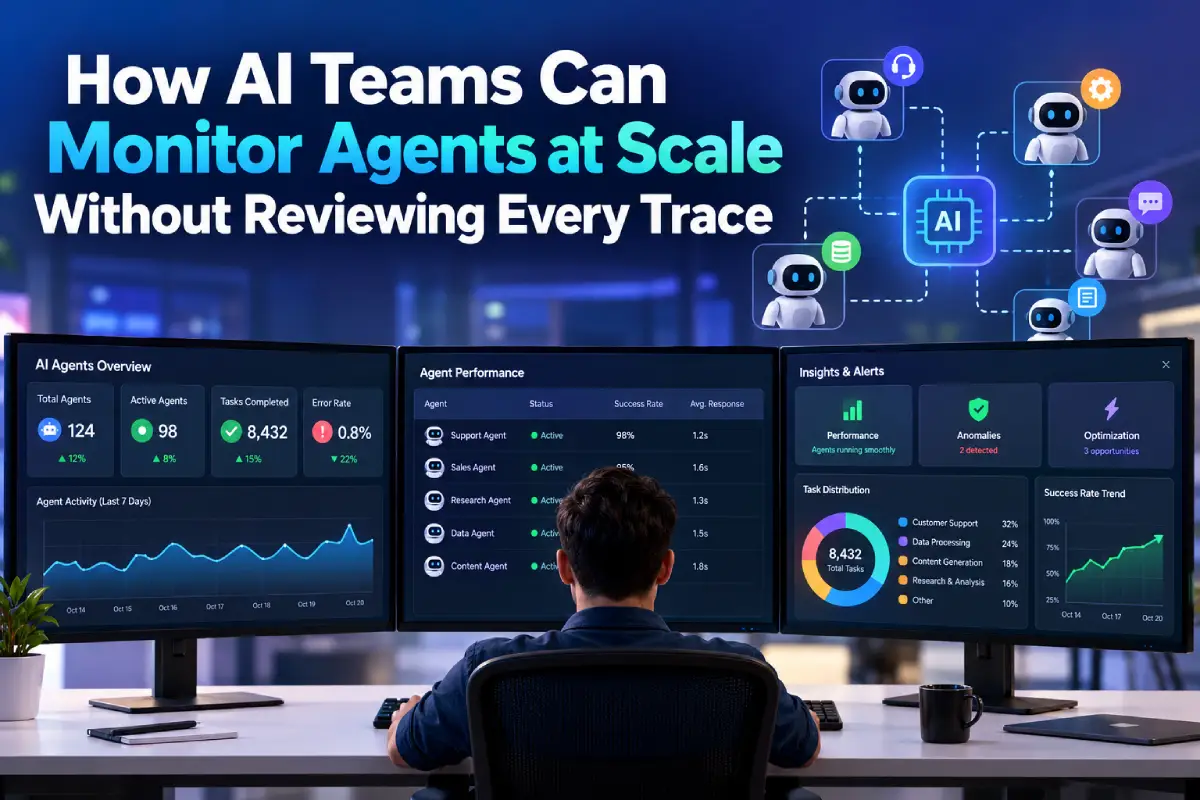
How AI Teams Can Monitor Agents at Scale Without Reviewing Every Trace:As autonomous AI agents move into production, engineering teams face a growing challenge: understanding thousands of AI traces without manually inspecting every interaction. Robert Hommes, co-founder of Moyai, approaches this challenge through three complementary capabilities: AI agent monitoring, automated evaluation, and behavioral anomaly detection. Together, these methods help engineering teams identify unusual agent behavior, assess whether it affects task quality, and prioritize the traces that require human investigation. Rather than reviewing every execution manually, teams can use automated analysis to focus on recurring failures, quality regressions, and deviations from expected behavior.
Why Manual Trace Review Cannot Scale

Agentic AI systems operate through interconnected decisions, model responses, and external tool interactions. A single task may generate multiple AI agent tool calls, intermediate outputs, and branching execution paths. As deployments grow, reviewing every trace becomes an increasingly inefficient way to maintain production AI reliability.
The research reflects this challenge. A December 2025 study, Measuring Agents in Production, surveyed 306 practitioners and conducted 20 in-depth case studies across 26 domains. Researchers identified reliability as the leading development challenge, highlighting persistent difficulties in ensuring and evaluating agent correctness. The study reported that 74% of surveyed production agents relied primarily on human evaluation. This finding highlights the role of human assessment in current agent evaluation practices and the potential need for complementary automated methods as deployments grow.
AI agent observability is the practice of collecting and analyzing execution traces, tool interactions, outputs, and task outcomes to understand how an AI agent behaves in production. Effective observability goes beyond logging activity: it helps engineering teams identify behavioral anomalies, evaluate task quality, and investigate failures that conventional infrastructure monitoring may not detect.
From AI Traces to Actionable Intelligence
Effective AI agent observability begins with capturing structured AI traces that represent an agent’s end-to-end execution. These traces can include model inputs and outputs, tool calls, execution sequences, latency, token consumption, and task outcomes.
However, collecting telemetry is only the first step. The real value comes from analyzing it systematically.
Automated monitoring can group similar traces into behavioral clusters, establish baselines for expected agent performance, and flag unusual execution patterns. For example, an agent that normally completes a customer-support task in four steps might suddenly make repeated tool calls, revisit previous actions, or return an incomplete answer despite a successful API response.
Individually, these events might appear insignificant. Across thousands of executions, however, recurring patterns can reveal AI agent behavioral anomalies, emerging regressions, or underlying system problems.
Clustering helps engineers understand which failures share common characteristics, while anomaly detection highlights behavior that differs from established patterns. Instead of opening every trace, teams can prioritize suspicious clusters, recurring deviations, and executions associated with measurable quality deterioration.
This approach transforms AI traces from passive records into actionable intelligence.
Why Automated Evaluation Matters as Much as Monitoring
An agent can complete a workflow without producing a correct result. Traditional infrastructure monitoring may report healthy services even when an AI agent hallucinates information, selects an inappropriate tool, or misunderstands a user’s objective.
AI agent monitoring identifies changes in execution behavior, while AI agent evaluation determines whether an agent’s outputs and actions meet defined quality criteria. Monitoring can flag repeated tool calls, unusual execution paths, or changes in latency. Evaluation can then assess whether the agent answered correctly, selected an appropriate tool, followed the required steps, and completed the intended task. Combining the two helps engineering teams distinguish operational irregularities from failures that materially affect results.
When monitoring detects a behavioral change, automated evaluation can help determine whether it represents a genuine quality regression or an acceptable variation. Teams can then investigate high-risk cases while routine executions continue to be assessed automatically.
This distinction is particularly important for silent AI agent failures: errors that do not trigger conventional system alerts but undermine the quality or reliability of the result.
A robust AI failure detection strategy combines operational signals with behavioral evidence. It asks not only whether an agent ran successfully, but whether it accomplished the intended task reliably.
Detecting Root Causes Instead of Chasing Symptoms
Identifying an anomaly is useful, but understanding why it occurred is what enables engineering teams to prevent recurrence. AI agent root-cause analysis connects unusual behavior to potential contributing factors, such as model changes, altered prompts, unexpected tool responses, or failures in upstream services.
For example, repeated errors may originate not from the agent’s reasoning but from a rate-limited external API. Alternatively, a model update might increase hallucinations or change how an agent selects tools. Without contextual analysis, engineers risk treating symptoms rather than correcting the underlying problem.
An AI agent reliability platform connects behavioral monitoring with evaluation so engineering teams can investigate failures based on their potential impact on task outcomes. Robert Hommes, co-founder of Moyai, works in this area of production AI reliability. Moyai focuses on behavioral anomaly detection and automated evaluation to help businesses identify unexpected agent behavior, assess whether it represents a meaningful failure, and investigate potential causes. This approach addresses a key challenge in agent observability: distinguishing unusual execution patterns from problems that compromise an agent’s reliability.
The objective is to connect AI failure detection with meaningful investigation, helping teams move from discovering an issue to understanding and addressing it.
Building a Scalable AI Agent Reliability Strategy
A practical monitoring strategy should combine three capabilities: comprehensive trace collection, automated behavioral analysis, and continuous agent evaluation. Together, these capabilities help teams identify emerging problems, prioritize engineering work, and measure whether corrective changes improve AI agent performance.
Human review remains essential, particularly for ambiguous failures, high-impact decisions, and validating automated evaluators. However, it should be concentrated where human judgment adds the most value rather than applied indiscriminately to every execution.
For teams operating production AI agents, this approach also supports autonomous agent monitoring as systems evolve. Monitoring can identify deviations from expected behavior, while evaluation helps determine whether those deviations affect quality. Over time, these feedback loops create a more systematic foundation for AI observability and production AI reliability.
The question for engineering leaders is no longer simply whether they can inspect an agent’s execution history. It is whether their monitoring systems can reliably surface the interactions that deserve attention.
To monitor AI agents without manually reviewing every trace, engineering teams can combine trace collection, behavioral anomaly detection, and automated evaluation. This enables them to prioritize unusual executions, assess the impact of potential failures, and direct human investigation toward cases that require judgment. For Robert Hommes and Moyai, the central challenge is making production AI reliability more systematic as autonomous agents become increasingly complex.