

Launching a cloud startup is easier than ever—but keeping users is the real challenge. Most products don’t fail because of bad ideas… they fail because of poor experience.
That’s where Cloud Startups and Smooth UX becomes critical.
If your product feels confusing, slow, or frustrating—even slightly—users leave. No second chances.
Let’s break down what smooth UX actually means for cloud startups and how you can use it to grow faster.
What Is Smooth UX in Cloud Startups?
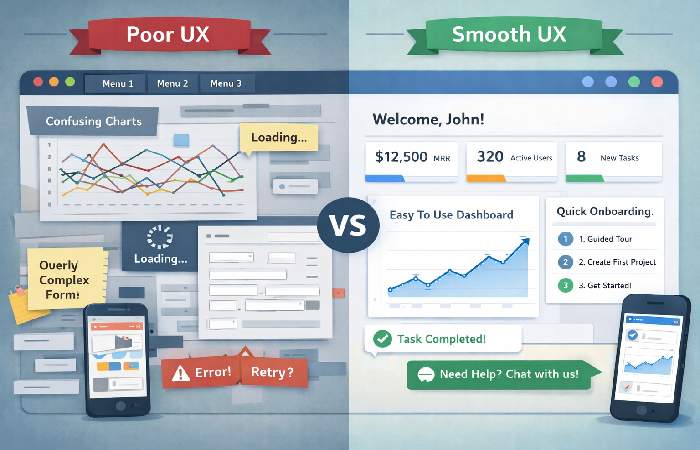
Smooth UX (User Experience) means your product feels:
- Effortless to use
- Fast and responsive
- Easy to understand—even for beginners
- Consistent across devices
For cloud startups (especially SaaS), UX is not just design—it’s the entire user journey.
From signup → onboarding → daily usage → support.
If any step feels clunky, users drop off.
Who This Is For (And Who It’s Not)
This is for:
- SaaS founders
- Product managers
- UI/UX designers
- Early-stage tech startups
This is NOT for:
- Offline-only businesses
- Products without user interaction (e.g., backend-only tools)
If your product has a dashboard, login, or workflow—UX matters.
Why Smooth UX Is a Game-Changer for Cloud Startups
Here’s the truth: users don’t compare you to competitors…
They compare you to the best experience they’ve ever had.
Key Benefits
1. Higher User Retention
If users enjoy using your product, they stick around.
2. Better Conversion Rates
Simple onboarding = more signups turning into active users.
3. Reduced Support Costs
Clear UX means fewer confused users asking for help.
4. Faster Growth (Word of Mouth)
People recommend tools that “just work.”
The Biggest UX Mistakes Cloud Startups Make
Let’s be honest—most startups get this wrong.
1. Overloading Features
Trying to impress users with too many options
→ Result: confusion
2. Ignoring Onboarding
No guidance for new users
→ Result: churn in first 5 minutes
3. Slow Performance
Even 2–3 seconds delay hurts engagement
4. Poor Mobile Experience
Cloud doesn’t mean desktop-only anymore
5. Designing for Themselves
Founders understand the product… users don’t
Step-by-Step: How to Build Smooth UX in Cloud Startups
Step 1: Understand the User Journey
Map this clearly:
- What problem are they solving?
- What’s their first action?
- What’s their “aha moment”?
👉 Example:
A project management tool’s “aha moment” = creating and completing a task.
Step 2: Simplify Onboarding
Your goal:
Get users to value as fast as possible
Best practices:
- Use tooltips or guided walkthroughs
- Avoid long forms
- Allow “skip for now” options
Step 3: Focus on Speed
Performance = UX
Improve:
- Page load time
- API response time
- UI transitions
Even micro-delays break flow.
Step 4: Design for Clarity, Not Creativity
Fancy UI ≠ good UX
Focus on:
- Clear buttons
- Logical navigation
- Familiar patterns
Users shouldn’t have to “figure things out.”
Step 5: Use Feedback Loops
Let users tell you what’s wrong.
Ways to collect feedback:
- In-app surveys
- Session recordings
- Heatmaps
Then improve continuously.
Real-World Example (Simple Scenario)
Imagine two cloud tools:
Tool A:
- Complicated dashboard
- No onboarding
- Slow loading
Tool B:
- Clean UI
- Quick tutorial
- Fast performance
Even if Tool A has more features…
Users choose Tool B
Why? Smooth UX wins.
Myths vs Facts About UX in Cloud Startups
| Myth | Reality |
|---|---|
| UX is just design | UX includes performance, flow, and usability |
| Only big companies need UX | Startups need it even more |
| More features = better product | Simplicity wins |
| UX is expensive | Bad UX is more expensive |
People Also Ask
How important is UX for SaaS startups?
Extremely important. UX directly impacts retention, conversions, and customer satisfaction.
What makes a cloud app user-friendly?
- Fast performance
- Simple navigation
- Clear onboarding
- Minimal friction
Can good UX replace marketing?
Not entirely—but it reduces the need for aggressive marketing because users stay and refer others.
Practical UX Tips You Can Apply Today
- Remove one unnecessary feature
- Improve your signup flow
- Reduce loading time by even 1 second
- Add a simple onboarding guide
- Test your product with a beginner
Small improvements → big results.
Common Pitfalls to Avoid
- Copying competitors blindly
- Ignoring user feedback
- Over-designing UI
- Skipping usability testing
- Not optimizing mobile experience
Advanced Insight (What Most Articles Miss)
Here’s something many don’t talk about:
👉 UX is your silent growth engine
You can spend thousands on ads…
But if UX is poor, users leave anyway.
On the flip side:
A smooth UX can turn:
- Users → loyal customers
- Customers → promoters
That’s how modern cloud startups scale.
FAQs
1. What is smooth UX in cloud startups?
It refers to a seamless, fast, and intuitive user experience across all interactions in a cloud-based product.
2. Why do users leave SaaS products quickly?
Mostly due to confusion, slow performance, or poor onboarding.
3. How can startups improve UX quickly?
Start with onboarding, speed optimization, and simplifying the interface.
4. Is UX more important than features?
In early stages, yes. A simple product with great UX beats a complex one.
5. How do I test my UX?
Use real users, feedback tools, and behavior tracking.
6. Does mobile UX matter for cloud apps?
Yes. Many users access tools on mobile devices.
7. What tools help improve UX?
Analytics tools, heatmaps, and session recordings are useful.
Conclusion
In today’s competitive market, Cloud Startups and Smooth UX are deeply connected. You can’t grow one without the other.
A smooth experience isn’t a luxury—it’s a necessity.
If your product is easy, fast, and enjoyable to use, users stay. And when users stay, growth becomes natural.
Focus less on adding features…
and more on removing friction.
That’s where real success begins.