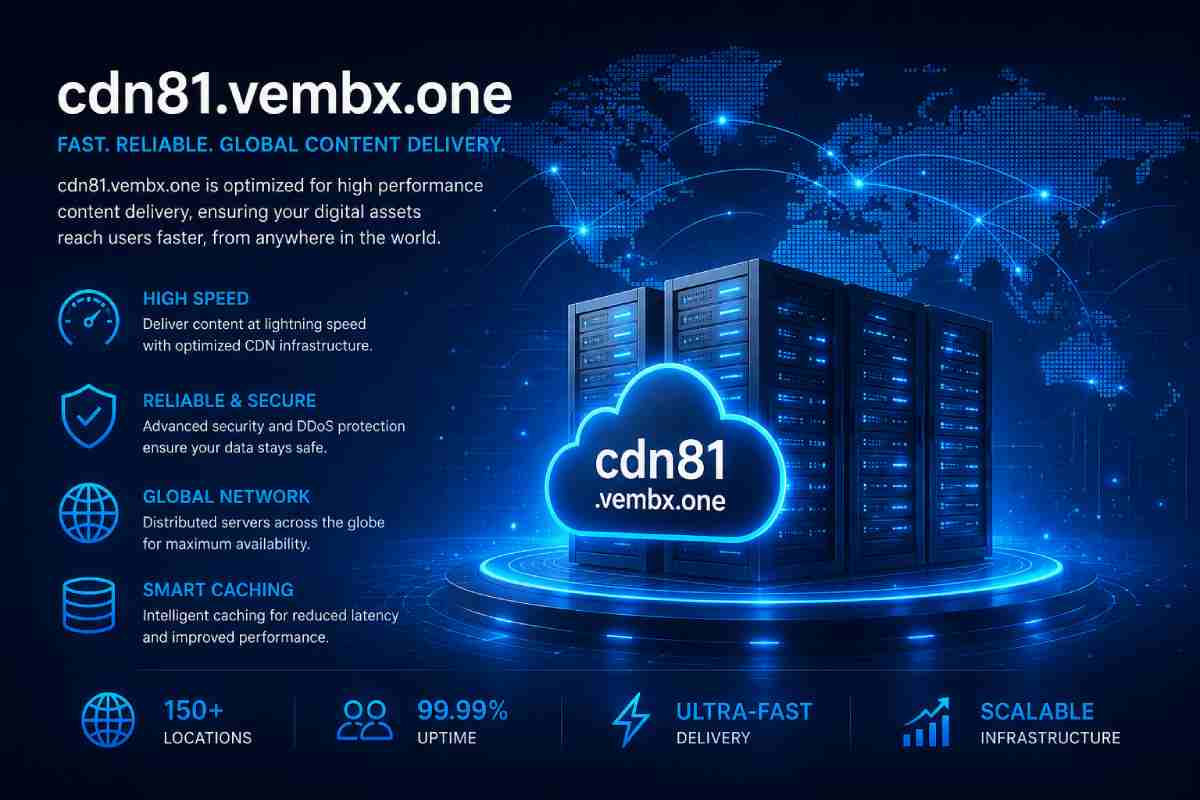
When you see a domain that looks like cdn81.vembx.one, the first thing to observe is likely cdn. Generally this signifies that we are dealing with a content delivery network or server end-point providing website files (like images, scripts etc). At the time of a live-check this domain produced a 502 Bad Gateway indicating that the server did not have the resources available at that specific point. Therefore, the discussion below is primarily a practical explanation of what a domain like that would generally look like.
Definition: What is a CDN Subdomain?

A CDN subdomain is a URL that is designed to deliver content from a physically closer, or at least more efficient server. In contrast to delivering all content from a single, central server, a CDN distributes the burden of traffic over many. This often speeds up the loading time of a page, speeds up access, and reduces congestion during peak traffic.
In its basic sense, a domain name like cdn81.vembx.one can be used to serve as a delivery point for: images
- CSS files
- JavaScript files
- video chunks
- downloadable assets
- cached page resources
That does not automatically mean the domain is malicious or safe. It only suggests the kind of technical role it may play.
Why Domain Names Like This Look Unusual
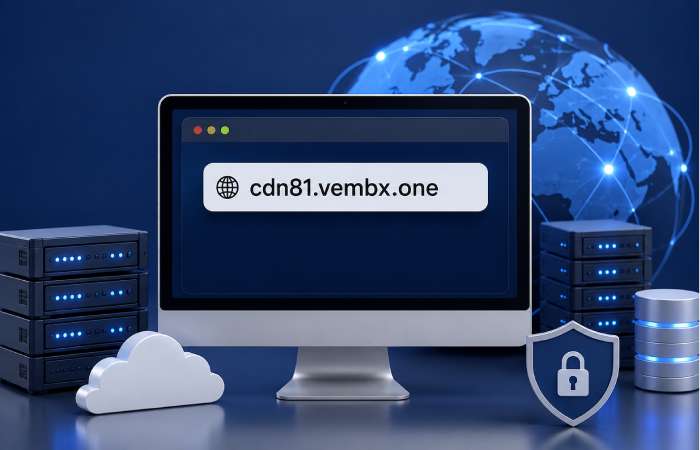
At first glance, cdn81.vembx.one feels more technical than brand-focused. That is common with infrastructure domains. A marketing website usually wants a clean name that people remember easily. A CDN endpoint, on the other hand, is often built for systems, not for public branding.
A name like this may include:
- A service label such as cdn
- A number like 81 to separate servers or clusters
- A parent domain like vembx.one
- An odd-looking top-level domain that you could select for your brand, its availability or for technical reasons
This kind of structure is often seen in backend systems, file delivery setups, or test environments.
Comparison Table: CDN Subdomain vs Main Website vs Static File Host
| Feature | CDN Subdomain | Main Website Domain | Static File Host |
| Main purpose | Deliver assets quickly | Show the website and content | Store files for direct access |
| Speed | Usually fast | Depends on hosting setup | Often fast for file access |
| Content type | Images, scripts, media, cached files | Articles, pages, forms, dashboards | Downloads, archives, uploads |
| User visibility | Often hidden from users | Clearly visible | Sometimes visible, sometimes not |
| Branding | Low | High | Low to medium |
| Typical risk | Misconfigured assets or broken links | Site downtime or errors | Expired links or file limits |
| Best for | Performance | Public-facing content | Storage and downloads |
This comparison helps explain why a domain with cdn in it often serves a very specific technical role rather than acting as a normal homepage.
How a CDN Usually Works
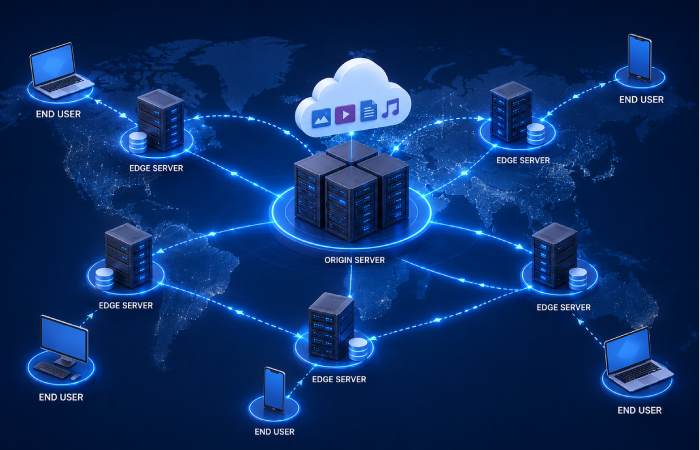
Basically, a CDN is a network of ‘helpers’ distributed all over. When you load a page, it doesn’t necessarily pull all the required data from one, single, distant server. It could be retrieving data from a closer node, or from a cached file.
The practical result is simple:
- Pages open faster
- Videos buffer less
- Websites handle more visitors
- Server load becomes easier to manage
Think of it as having your best-sellers in many stores nearby instead of asking one warehouse to send everything out to everybody. The nearest it is to you the quickest it is delivered.
Possible Uses of a Domain Like cdn81.vembx.one
It is possible to use a domain of this structure for many applications. Some of the commonest ones are:
- Serving website assets: logos, icons, fonts, and page styles.
- Delivering media files: images, audio, or video segments.
- Caching application content: reducing repeated requests to the main server.
- Testing web infrastructure: temporary or internal setups.
- Separating traffic: keeping high-volume files away from the main application.
In many systems, the main website and the CDN endpoint work together quietly in the background. The visitor sees a normal page, but the assets may come from a different domain.
Comparison Table: Pros and Cons of CDN-Based Delivery
| Aspect | Advantages | Drawbacks |
| Performance | Faster loading and lower latency | Depends on CDN health |
| Reliability | Helps absorb traffic surges | A CDN outage can break assets |
| Scalability | Supports more users at once | More configuration needed |
| Security | Can hide origin servers | Misconfiguration can expose files |
| Maintenance | Easier asset distribution | Harder troubleshooting if links fail |
The CDN has its benefits, but it’s not a magic bullet. A server down, routed incorrectly or misconfigured would just lose your image, style or page loading.
What a 502 Bad Gateway Means in Plain Language
Status 502 really means that one server tried to talk to another, and that other server gave a ‘no’ back to the server trying to talk to it. In the vast majority of cases, you cannot be the cause. The most frequent causes for the status are:
- The upstream server is down
- The gateway is misconfigured
- The server is overloaded
- A proxy or load balancer cannot reach the next service
So if someone opens CDN81.vembx.one and gets a 502, the issue is likely on the hosting side rather than on the user’s device.
When You See a Domain Like This, What Should You Check?
If you are evaluating a domain that looks technical or unfamiliar, these checks are useful:
- Does it load consistently?
- Does it serve the content it claims to serve?
- Are the files expected, or do they look random?
- Is the URL used by a trusted website or app?
- Does the domain return normal headers and stable responses?
- Is there a visible ownership trail or documentation?
A domain can be perfectly legitimate and still look strange. The trick is to judge it by behavior, not by appearance alone.
Practical Comparison: Safe-Looking vs Suspicious Behavior
| Behavior | Usually Normal | Worth Investigating |
| Loads asset files for a known app | Yes | No |
| Returns 502 occasionally during maintenance | Sometimes | Monitor if frequent |
| Appears in browser only as a hidden resource | Often | Check source of the page |
| Requests login credentials unexpectedly | No | Yes |
| Redirects through many unknown domains | No | Yes |
| Serves random downloads with no context | No | Yes |
This kind of table is useful because the domain name itself does not tell the full story. The behavior matters far more.
Simple Definition: Origin Server vs CDN
An origin server is the original source of the content. A CDN copies or caches that content and distributes it closer to users. If the origin is the kitchen, the CDN is the set of serving stations. The meal is still the same, but it reaches the table faster.
That distinction matters because when a CDN subdomain fails, the main website may still be alive. Or the reverse may happen. The web is built from layers, and each layer can fail in a different way.
Bullet Points: Why Businesses Use CDN Subdomains
- They reduce load on the main server.
- They improve page speed for global visitors.
- They keep high-traffic files separate from the core website.
- They help websites survive sudden traffic spikes.
- They make media-heavy pages easier to manage.
- They support better user experience on slower networks.
Comparison Table: Traditional Hosting vs CDN-Backed Hosting
| Item | Traditional Hosting | CDN-Backed Hosting |
| Content delivery | From one central server | From distributed nodes |
| Speed for distant users | Slower | Faster |
| Traffic handling | More strain on origin | Better load distribution |
| Downtime impact | Often more severe | Sometimes reduced |
| Setup complexity | Simpler | More advanced |
| Best use case | Small sites, internal tools | Public sites, media-rich apps |
For modern websites, CDN-backed hosting is often the better option when speed and reliability matter.
A Human View of cdn81.vembx.one
If a person has landed on a domain like cdn81.vembx.one, it’s possible that they’ll get an unfriendly home page – or perhaps nothing visible, a file directory, blocked request, or error message from a server. This is because the domain has likely only one purpose: to deliver files as fast as possible.
That can make it look rather strange, but strange is not necessarily threatening. Technical domain names often don’t have much more than that since they were designed for machines rather than human eyes and hands. In that sense, cdn81.vembx.one reads more like infrastructure than a public brand.
Still, a little caution is healthy. Any unfamiliar domain should be treated carefully until its purpose is clear.
What Makes a Good CDN Endpoint?
A strong CDN endpoint usually has these qualities:
- stable response times
- correct cache behavior
- HTTPS support
- predictable file paths
- low error rates
- clean integration with the main website
When a CDN endpoint isn’t configured correctly it can result in broken styles, missing images, and slow loading times on the website. This is why the teams consistently test the domain and also keep a watchful eye on it.
Final Thoughts
It looks like cdn81.vembx.one is the sort of name that is more suitable to a technical delivery layer, not something users see on their browsers. Since the URL returned a 502 Bad Gateway when I tried to test it, there is not really a concrete live page to test it from an outside perspective at the moment.
This seems to make the most sense that it’s not your typical web page homepage but actually a server-side asset/ CDN endpoint. These sort of domains are prevalent in modern web architectures, where speeds, caching and traffic handling are of critical importance on par with what users see visually.
When describing the domain in your article or for SEO, stick to the general function of CDN subdomains, what a 502 error actually entails and the prudent approach to a new, unknown web endpoint: that there isn’t anything to panic about.