
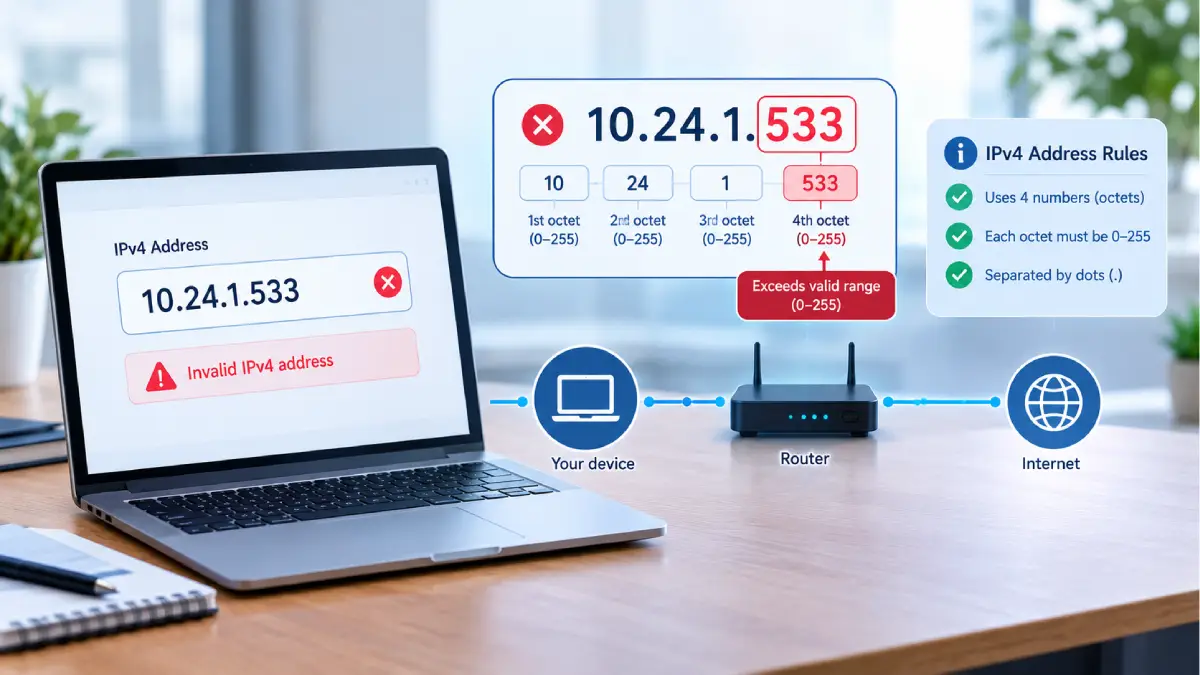
If you see 10.24.1.533 in a search result, in network logs, in config files, application messages or in any kind of troubleshoot screen, you might want to ask yourself what it is. Visually, it might appear to be an IPv4 address because there are four figures separated by dots.
The problem, however, is that 10.24.1.533 is not a valid IPv4 address.
The problem is easy to explain. IPv4 addresses are made of four figure components, which is called octets, that have values from 0 to 255 inclusive. The last figure here, 533, is out of range.
The first three figures could also make the string suggest a private network address. The range 10.0.0.0/8 has been formally designated to private networks, but that doesn’t mean that any number starting with 10 must be valid.
In this guide, we are going to examine what 10.24.1.533 most likely is, and why it is not valid, and talk about how private networks are built as well as actions you might want to take.
What Is 10.24.1.533?
10.24.1.533 looks like an IPv4 address, but it does not meet the rules for a valid IPv4 address.
An IPv4 address normally looks like this:
192.168.1.10
It has four parts:
- 192
- 168
- 1
- 10
Each part can contain a number from 0 to 255.
The same rule applies to addresses beginning with 10. For example:
- 10.0.0.1 — valid format
- 10.24.1.1 — valid format
- 10.24.1.50 — valid format
- 10.24.1.255 — valid format
- 10.24.1.533 — invalid
The problem with the searched value is therefore not the 10.24.1 portion. It is the final number, 533.
Is 10.24.1.533 a Valid IPv4 Address?
No.
The maximum value permitted in an individual IPv4 octet is 255. Since the final octet in 10.24.1.533 is 533, the address is outside the valid IPv4 format.
For example:
| Address | Valid? | Reason |
| 10.24.1.1 | Yes | All four octets are 0–255 |
| 10.24.1.50 | Yes | All four octets are valid |
| 10.24.1.200 | Yes | All four octets are valid |
| 10.24.1.255 | Yes | 255 is the maximum octet |
| 10.24.1.256 | No | 256 exceeds 255 |
| 10.24.1.533 | No | 533 exceeds 255 |
Therefore, if you expected 10.24.1.533 to be an IP address, there is probably a transcription, formatting or data-entry problem.
Why 10.24.1.533 Is Invalid
IPv4 uses 32 bits divided into four groups of 8 bits.
Each 8-bit group can represent:
0 through 255
That is why an IPv4 address has the familiar structure:
A.B.C.D
where:
- A = 0–255
- B = 0–255
- C = 0–255
- D = 0–255
For 10.24.1.533:
- 10 → valid
- 24 → valid
- 1 → valid
- 533 → invalid
The final value cannot fit into an 8-bit IPv4 octet.
This is an important distinction because simply looking at the first three numbers is not enough to determine whether an IP address is valid.
Is 10.24.1.533 a Private IP Address?
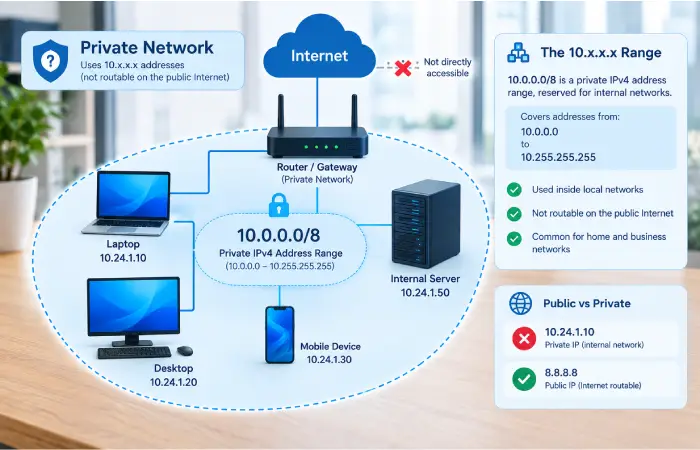
It resembles a private IP address, but technically 10.24.1.533 itself is not a valid IP address.
The reason it looks like one is that the 10.x.x.x structure belongs to the private IPv4 address space.
IANA lists:
10.0.0.0/8
as Private-Use address space. This covers:
10.0.0.0 through 10.255.255.255.
RFC 1918 also defines the three main private IPv4 ranges:
- 10.0.0.0/8
- 172.16.0.0/12
- 192.168.0.0/16
These addresses are commonly used inside private networks such as home networks, offices, schools, data centres and enterprise environments.
However, being inside a private range does not override the basic IPv4 formatting rules.
10.24.1.50 can be a valid private IPv4 address.
10.24.1.533 cannot.
How IPv4 Addresses Work
IPv4 is the Internet Protocol version used to identify devices and network interfaces.
A conventional IPv4 address contains four octets separated by dots.
For example:
192.168.1.25
The four octets are:
192 | 168 | 1 | 25
Each one has eight binary bits.
Eight bits can represent 256 possible values:
0–255
This is why 255 is the maximum number that can appear in a standard IPv4 octet.
Example
Consider:
10.24.1.100
Its components are:
| Octet | Value | Valid? |
| 1 | 10 | Yes |
| 2 | 24 | Yes |
| 3 | 1 | Yes |
| 4 | 100 | Yes |
Now consider:
10.24.1.533
| Octet | Value | Valid? |
| 1 | 10 | Yes |
| 2 | 24 | Yes |
| 3 | 1 | Yes |
| 4 | 533 | No |
That single invalid octet makes the complete address invalid.
What Could 10.24.1.533 Actually Mean?
Without knowing where you found the string, it is impossible to determine exactly what the author or system intended.
There are several reasonable possibilities.
1. It could be a typing mistake
The most obvious explanation is a typo.
For example, someone may have intended to enter:
10.24.1.53
instead of:
10.24.1.533
Or they may have intended another value entirely.
You should check the original source rather than guessing.
2. It could be incorrectly formatted data
Some software systems combine numbers, identifiers or log information into a single field.
If 10.24.1.533 came from a database, application log, spreadsheet or copied text, it may not actually represent an IP address.
3. It could contain an additional identifier
In some logs, network information may appear next to port numbers, IDs or other values.
For example, a system might display an IP address together with another number. If formatting is lost while copying the information, the result can look like an invalid IP.
4. It could be an automatically generated string
Search results currently contain several pages that use 10.24.1.533 as part of unrelated technical-looking descriptions. These pages do not provide reliable evidence that the string represents a recognised technology or service.
For this reason, it is safer to verify the original context rather than assigning a technical meaning to the number based only on its appearance. For more related articles visit our website.
How to Find the Correct IP Address
If you encountered 10.24.1.533 while trying to identify your own device, server or router, do not simply replace 533 with another number.
Instead, check the original device or operating system.
On Windows
Open Command Prompt and run:
ipconfig
Look for an entry such as:
IPv4 Address
You may see an address similar to:
10.24.1.50
or:
192.168.1.25
The exact address depends on your network.
On Linux
You can use:
ip addr
or:
ip address
Look for the relevant network interface and its IPv4 address.
On macOS
Network information can be checked through System Settings, or with suitable network commands in Terminal.
On a router
Log in to the router’s administration interface and check the LAN or connected-device information.
Do not assume that an address shown in a random website or search result is your actual local IP.
Common Mistakes When Reading IP Addresses
Mistake 1: Assuming every four-part number is an IP address
Four numbers separated by dots may look like an IPv4 address, but appearance alone does not make it valid.
Every component must satisfy IPv4 formatting rules.
Mistake 2: Assuming 256 or higher is acceptable
It is not.
For example:
10.0.0.256
is invalid.
So is:
10.0.0.533
The largest possible value for an IPv4 octet is 255.
Mistake 3: Confusing an IP address with a port number
An IP address and a port number serve different purposes.
For example:
10.24.1.50:8080
contains:
- IP address: 10.24.1.50
- Port: 8080
A number such as 533 could potentially be meaningful as another field in a technical log, but that does not make 10.24.1.533 a valid IP address.
Mistake 4: Assuming a private IP identifies someone publicly
Private addresses are reused across many independent networks.
IANA explains that private address blocks can be used by many different networks, so an individual private address does not uniquely identify a person, company or public Internet connection.
Private IPv4 Address Ranges
There are three main private IPv4 ranges defined by RFC 1918.
| Private Range | CIDR | Common Use |
| 10.0.0.0 – 10.255.255.255 | 10.0.0.0/8 | Large private networks |
| 172.16.0.0 – 172.31.255.255 | 172.16.0.0/12 | Private networks |
| 192.168.0.0 – 192.168.255.255 | 192.168.0.0/16 | Home and small-office networks |
These ranges are reserved for private networking and are not globally unique public Internet addresses.
Common examples include:
- 10.0.0.1
- 10.24.1.10
- 172.16.0.1
- 172.20.10.5
- 192.168.0.1
- 192.168.1.1
But an address such as 10.24.1.533 remains invalid because the final octet is outside the permitted range.
Can You Access a 10.x.x.x Address from the Internet?
Normally, a private 10.x.x.x address is used within a private network rather than being directly reachable as a public Internet destination.
IANA states that private-use addresses should not appear on the public Internet.
A device inside a local network can communicate with another device using private addresses, subject to the network’s routing and firewall configuration.
For example:
Laptop → Router → Local Server
might involve private addresses such as:
10.24.1.20
and:
10.24.1.50
The router may then use another mechanism, such as Network Address Translation (NAT), when devices communicate with the public Internet.
The important point is that a private IP is not the same thing as a public Internet address.
Is 10.24.1.533 a Security Threat?
The string alone does not prove that there is a security threat.
Because 10.24.1.533 is not a valid IPv4 address, it should first be treated as an incorrectly formatted value or another type of identifier.
If you found it in a security log, firewall alert or suspicious message, investigate the surrounding information instead of relying on this number alone.
Useful information may include:
- Timestamp
- Source field
- Destination field
- Protocol
- Port
- Application name
- Hostname
- Complete log entry
- Other IP addresses
- Error message
- Device or software generating the record
If the surrounding record contains a valid address, that may reveal what the original data was intended to represent.
What Should You Do If You See 10.24.1.533?
Follow these steps:
- Do not assume it is a valid IP address.
- Check whether the value was copied correctly.
- Look at the original log, configuration or application.
- Check whether the number after the final dot is actually a separate field.
- Verify the device’s current IPv4 address.
- Compare the value with the surrounding network information.
- Check whether the system uses private addressing.
- If necessary, ask the network administrator or software vendor for clarification.
Most importantly, do not randomly change the number and assume that you have found the correct address.
Why the 10.24.1 Portion Looks Familiar
The beginning of the string is plausible because addresses beginning with 10. are part of the private IPv4 space.
For example:
10.24.1.1
is structurally valid.
10.24.1.100
is also structurally valid.
10.24.1.254
is valid.
But:
10.24.1.533
is not.
This is a useful example of why IP-address validation requires checking every octet, not just the first portion.
Comparison Tables / Useful Lists
Valid vs Invalid Examples
| Example | Status | Explanation |
| 10.24.1.1 | Valid format | All octets are within 0–255 |
| 10.24.1.50 | Valid format | Valid IPv4 structure |
| 10.24.1.200 | Valid format | Valid IPv4 structure |
| 10.24.1.255 | Valid format | 255 is permitted |
| 10.24.1.256 | Invalid | 256 is greater than 255 |
| 10.24.1.533 | Invalid | 533 is greater than 255 |
Private IPv4 Ranges
| Range | CIDR | Type |
| 10.0.0.0 – 10.255.255.255 | 10/8 | Private-use |
| 172.16.0.0 – 172.31.255.255 | 172.16/12 | Private-use |
| 192.168.0.0 – 192.168.255.255 | 192.168/16 | Private-use |
IANA confirms these ranges as private-use address space.
FAQ’s
Is 10.24.1.533 a real IP address?
No. 10.24.1.533 is not a valid IPv4 address because the final octet, 533, is greater than the maximum allowed value of 255.
What does 10.24.1.533 mean?
By itself, it does not represent a valid IPv4 address. It may be a typo, malformed data or an identifier that has been incorrectly interpreted as an IP address.
Is 10.24.1.533 a private IP?
Not exactly. The 10.0.0.0/8 range is reserved for private use, but 10.24.1.533 itself is invalid because 533 is outside the permitted octet range.
What is the maximum number in an IPv4 address?
Each IPv4 octet can contain a value from 0 to 255. Therefore, 255 is the maximum value for any individual section.
Can a private IP start with 10.24?
Yes. Addresses such as 10.24.1.1 and 10.24.1.100 can be valid private IPv4 addresses, provided every octet is within the valid range.
Can 10.24.1.533 be accessed from the Internet?
No, not as a valid IPv4 destination. The address itself is malformed. In addition, the broader 10.0.0.0/8 range is reserved for private networks rather than public Internet addressing.
How can I check my actual IP address?
On Windows, you can use ipconfig. On Linux, ip addr can show network-interface addresses. You can also check the network settings on your router or device.
Why do I keep seeing 10.24.1.533 online?
Current search results contain several low-quality pages that repeat the exact string in unrelated technical-looking contexts. There is no authoritative evidence that the string identifies a recognised product or service.
Final Verdict
10.24.1.533 is not a valid IPv4 address.
Its first three octets are analogous to an address in the private 10.0.0.0/8 range; however, 533 is a value which is greater than the limit for an IPv4 address Octet, 255. This address range 10.0.0.0/8 is allocated for use by IANA for private addresses.
If you came across 10.24.1.533 in some log, or a computer or networking application or even in some write-up and web article, examine the context where it appeared to figure out if it’s just a typing mistake, some incorrectly formed data, or a different kind of identifier.
Treat unsubstantiated web page explanations of 10.24.1.533 as invalid evidence that 10.24.1.533 denotes any one particular software product, user authentication, networking system or service.
Use IANA’s private-address documentation, IANA’s 10.0.0.0/8 designation and RFC 1918 as authentic references for the private IPv4 address ranges.