
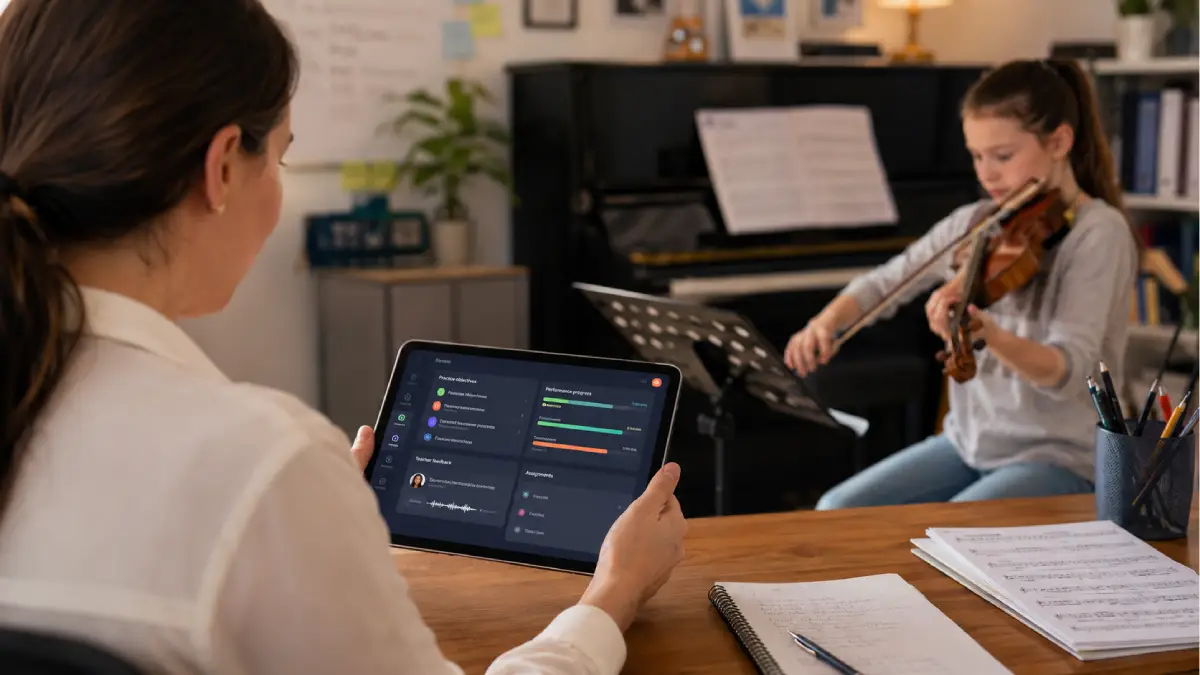
If you have come across studiosoapp.com while researching music education technology, you may find the current search results confusing. The name “Studioso” now appears in connection with more than one digital education product.
Historically, however, StudiosoApp.com was associated with a music education application designed to connect music teachers with their students. The original concept focused on improving practice between lessons, giving teachers tools to set objectives and assignments, and helping students keep track of their work. Historical sources also describe features for progress monitoring and recording assignments.
The important distinction is that this older Studioso should not automatically be confused with the newer Studioso AI study application found at studioso.dev. The newer product focuses on AI-assisted academic study, including document analysis, question scanning, audio transcription and AI tutoring, and is associated with a different developer.
So, what exactly was StudiosoApp.com, how did it work, and what can still be verified about it?
What Was StudiosoApp.com?
StudiosoApp.com was associated with Studioso, a music education technology startup that aimed to improve the relationship between music lessons and the practice students completed outside the classroom.
The idea addressed a familiar problem in instrumental education: a teacher might spend an hour with a student during a lesson, but the student would then spend much of the week practising without direct supervision.
Studioso was designed to extend the teacher’s guidance beyond the lesson.
Historical descriptions say the platform connected music teachers and students, allowed teachers to share assignments and objectives, and enabled practice and progress to be monitored digitally.
The concept therefore was not simply a digital sheet-music application. It was closer to a practice-management and teacher-student communication platform for music education.
How Did the Studioso Music Education App Work?
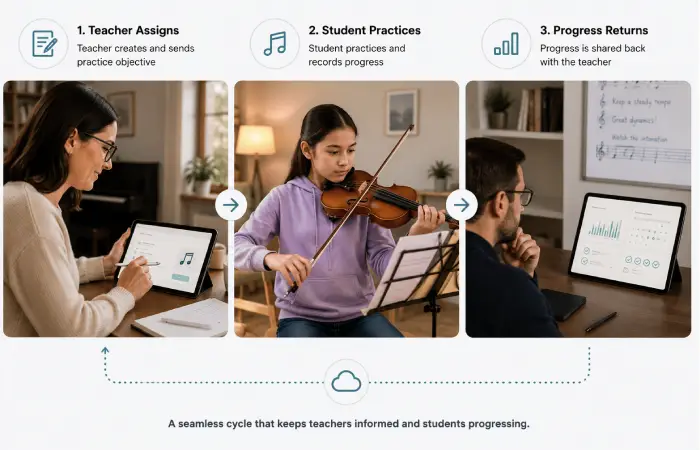
The original Studioso ecosystem was built around two sides: the teacher and the student.
The Teacher Side
The teacher-facing application was designed to help instructors manage students outside their normal lesson time.
Historical descriptions indicate that teachers could:
- Send weekly practice objectives.
- Track students’ progress.
- Review practice logs.
- Create recording assignments.
- Listen to student recordings.
- Grade or assess recordings.
- Communicate instructions outside the classroom.
- Manage students and ensembles.
This approach was intended to give teachers greater visibility into what happened between lessons.
Instead of relying entirely on a student remembering verbal instructions from a previous lesson, the teacher could provide digital objectives and review evidence of practice.
The Student Side
The student-facing experience was focused on completing practice work and keeping a record of progress.
One historical description says the student application could automatically log what students practised and how long they practised. Students could also complete recording assignments created by their teachers.
That created a basic cycle:
Teacher sets objective → student practises → practice is recorded → teacher reviews progress → next objective is assigned.
For music education, that workflow is particularly useful because progress is not determined only by what happens during the weekly lesson.
Key Features of the Original Studioso App
Practice Tracking
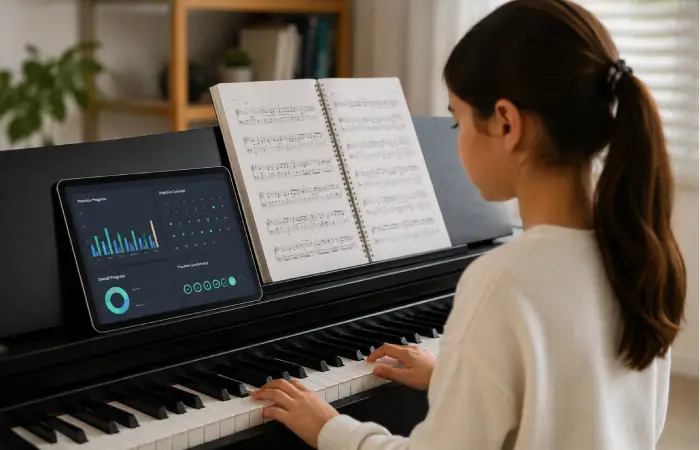
Practice tracking was one of the central ideas behind Studioso.
Rather than treating practice as something that happened entirely outside the teacher’s view, the platform attempted to make it measurable.
Historical descriptions indicate that students could record their practice activity, including how long they practised, while teachers could view progress through the teacher application.
This could give teachers a better understanding of consistency between lessons.
It also gave students a visible record of their own work.
Weekly Practice Objectives
Another important feature was the ability for teachers to establish weekly practice objectives.
Music teachers commonly give students specific goals such as:
- Practise a difficult passage slowly.
- Work on a particular technique.
- Prepare a section for the next lesson.
- Repeat an exercise a specified number of times.
- Prepare a recording.
Studioso was designed to turn these types of instructions into a more structured digital workflow.
A historical teacher review specifically describes the ability to add warm-ups, teacher-set objectives and student objectives.
Recording Assignments
Recording was another notable part of the platform.
Teachers could create recording assignments with deadlines, while students could record and submit their performances through the student application. Teachers could then listen to and assess those recordings.
This feature was particularly relevant for music because audio or video performance can provide information that a simple practice timer cannot.
A teacher could potentially hear whether a student was applying the technique or musical instructions discussed during a lesson.
Teacher-Student Communication
Studioso was also intended to reduce the communication gap between lessons.
Historical descriptions state that the teacher and student applications could be paired so teachers could communicate instructions outside the classroom or studio.
This makes the product different from a conventional practice timer.
The broader concept was to connect:
instruction + practice + communication + progress tracking.
Technique Library
The original Studioso concept also included a Technique Library.
A historical startup description describes this as a collection of practice techniques written by teachers. The intention was to help students practise efficiently and correctly rather than simply spending more time with their instruments.
That distinction matters.
Good practice is not necessarily the same as long practice. A student can repeat the wrong technique for an hour and make little progress. A structured technique resource can instead help direct attention towards how an exercise should be approached.
Who Was Studioso Designed For?
Studioso was primarily aimed at the two sides of private or institutional music education:
| User | Intended benefit |
| Music teachers | Set objectives, monitor progress and manage assignments |
| Music students | Follow practice goals and record practice |
| Music schools | Support structured teacher-student workflows |
| Ensembles | Manage students and recording-related activities |
The product was therefore more specialised than a general productivity app.
Its focus was the relationship between music instruction and independent practice.
The Story Behind Studioso
Studioso was founded by Ocean Salazar-Ferrer and developed as an education technology startup.
The University of Minnesota’s Carlson School reported in 2018 that Studioso had been selected as a semifinalist in the MN Cup Youth Division. The university described the company as modernising music education through a mobile app that connected students with teachers, guided practice and enabled progress tracking.
USC Rossier later profiled Salazar-Ferrer as part of its EdVentures programme. Its account described Studioso as a mobile app for sharing assignments and tracking student practice and progress in real time. At that point, the company was based around Minneapolis–St Paul and was working with pilot schools in Minnesota.
A separate startup profile records Studioso LLC as an Eden Prairie, Minnesota company and describes its purpose as connecting music teachers with students.
These sources provide useful historical evidence, but they should not be interpreted as proof that the same service is operating today.
Was Studioso Available on Mobile Devices?
Yes, historical evidence indicates that Studioso was developed as a mobile application.
The teacher and student components were available across mobile platforms during the product’s development, with historical descriptions referring to both iOS and Android versions.
There is also evidence of separate teacher and student applications.
For example, a preserved description of Studioso for Teacher identifies functions such as weekly practice objectives, practice logs, student progress and recording assignments.
A third-party record of the iOS teacher application lists version 2.2.12 and a developer update dated May 2020. Because this is an archived third-party listing rather than a current official store page, it is better treated as historical evidence rather than confirmation of current availability.
Is StudiosoApp.com Still Active?
This is where caution is necessary.
When checked for this article, studiosoapp.com did not return an accessible website, so the original service’s current operational status could not be independently confirmed.
There is historical evidence that the domain was associated with Studioso, including references to its privacy policy and terms pages in archived app information.
However, an inaccessible website does not by itself prove that a company has formally shut down.
The safest conclusion is:
The historical Studioso music-education service is well documented, but its current operational status could not be verified from an accessible official website.
This distinction is important when researching older technology products.
Is StudiosoApp.com the Same as the New Studioso AI App?
No evidence found in the current research supports treating them as the same product.
This is one of the most important points for anyone searching for Studioso today.
The newer Studioso AI product at studioso.dev describes itself as an AI study companion. Its features include document uploads, question scanning, lecture recording, transcription, AI assistance and YouTube summarisation. Its website identifies the product as an AI-powered study companion.
The current App Store listing identifies its developer as LIBERTY GLOBAL DEVELOPMENT LLC and describes features such as homework scanning, document summarisation, YouTube summaries, audio transcription and smart notes.
The historical Studioso associated with studiosoapp.com, on the other hand, was a music-education product associated with Studioso LLC and focused on teachers, students, music practice and performance assignments.
The difference at a glance
| Area | Historical StudiosoApp.com | Current Studioso AI |
| Main focus | Music education | General academic study |
| Teacher-student connection | Yes | Not the primary positioning |
| Practice tracking | Yes | Not the core feature |
| Recording assignments | Yes | Audio recording is available, but for study workflows |
| AI tutoring | Not identified in historical sources | Yes |
| Document summarisation | Not a documented core feature | Yes |
| Question scanning | Not a documented core feature | Yes |
| Historical developer/company | Studioso LLC | Liberty Global Development LLC |
The similar name is therefore not enough to establish that the two products are connected.
What Made the Original Studioso Concept Interesting?
The most interesting part of Studioso was its attempt to solve a real weakness in traditional music education: the gap between lessons.
A weekly music lesson gives a teacher limited time with each student. Most actual practice happens independently.
That creates several challenges.
A student may:
- Forget the teacher’s instructions.
- Practise inefficiently.
- Avoid difficult sections.
- Lose motivation.
- Fail to practise consistently.
- Struggle to know whether they are improving.
For teachers, the opposite problem exists.
They may have limited visibility into what happens after the student leaves the studio.
Studioso’s model attempted to connect these two sides digitally.
The idea was not to replace the teacher. Instead, technology was intended to make the teacher’s guidance more useful between lessons.
That philosophy is reflected in historical descriptions of the product, which emphasised teacher-student communication, guided practice, accountability and progress.
What Happened to Studioso?
The public evidence available today does not provide enough information to give a definitive explanation of what happened to the original company.
Historical sources show that Studioso was actively being developed and promoted during the late 2010s and that it participated in startup and education programmes. USC’s 2019 account described pilot schools, users and an effort to expand the company.
There is also evidence of continued application development into 2020 from archived application information.
After that period, publicly accessible evidence becomes much less clear.
It would therefore be inappropriate to claim that Studioso definitely shut down, was acquired, rebranded or became another company without stronger evidence.
For readers researching the product today, the practical conclusion is simply that the original service cannot currently be verified as an active platform through its historical website.
Should You Still Look for the Original Studioso App?
If you are researching Studioso because you remember using the music practice platform, it is worth first confirming that you mean the older music education product.
Search results can now lead you towards the newer Studioso AI application, which serves a different purpose.
If your goal is to find a historical reference, information about the original teacher/student workflow is still available through university profiles and archived product descriptions.
If your goal is to find a currently supported music-practice platform, however, the historical Studioso service should not be assumed to be available simply because references to it remain online.
Why the Studioso Story Still Matters
The original Studioso concept illustrates an important direction in education technology: technology does not always need to replace instruction to be useful.
In music education, digital tools can support:
- Better communication.
- More structured practice.
- Clearer assignments.
- Progress visibility.
- Remote feedback.
- Accountability between lessons.
Studioso was an early example of trying to bring these functions together in a dedicated music-education workflow.
Its historical approach also highlights an important distinction between practice time and effective practice.
Simply spending more minutes with an instrument does not necessarily mean a student is practising correctly. Teacher guidance, measurable objectives and feedback can be just as important.
Historical Studioso at a Glance
| Item | Verified information |
| Product | Studioso |
| Domain associated with it | studiosoapp.com |
| Primary industry | Music education technology |
| Core users | Music teachers and students |
| Main purpose | Connecting teachers and students and improving practice |
| Teacher features | Objectives, progress tracking, practice logs, recordings |
| Student features | Practice tracking and recording assignments |
| Technique resources | Teacher-created Technique Library |
| Historical location | Minnesota, USA |
| Current website status | Not accessible in the current check |
| Current operational status | Not independently verified |
Historical company and product information is supported by university, startup and archived application sources.
Studioso Name Confusion
| Search result | Focus | Developer/company evidence |
| Historical Studioso / studiosoapp.com | Music education | Studioso LLC |
| Current Studioso AI / studioso.dev | AI study assistant | Liberty Global Development LLC |
The current App Store listing explicitly identifies Liberty Global Development LLC for the newer AI application.
FAQ’s
What is StudiosoApp.com?
StudiosoApp.com was historically associated with Studioso, a music education application designed to connect music teachers with students and support practice, assignments and progress tracking.
What did the Studioso music app do?
The original platform supported teacher-student communication, practice objectives, practice logs, progress monitoring and recording assignments.
Was Studioso designed for music teachers?
Yes. Historical descriptions specifically identify teacher-facing functionality for assigning objectives, monitoring students and managing recording assignments.
Did Studioso track student practice?
Historical product descriptions indicate that the student application could log what students practised and how long they practised, while teachers could view progress.
Could students submit recordings through Studioso?
Yes. Historical descriptions state that teachers could create recording assignments that students completed through the student application, after which teachers could listen to and assess the recordings.
Is StudiosoApp.com still available?
The original studiosoapp.com website was not accessible during the current check. Historical evidence confirms that it existed, but its present operational status could not be independently verified.
Is Studioso AI the same as StudiosoApp.com?
There is no reliable evidence in the sources reviewed that establishes that they are the same product. The newer Studioso AI application has a different focus and identifies Liberty Global Development LLC as its developer.
Who founded the original Studioso?
Historical sources identify Ocean Salazar-Ferrer as the founder of Studioso. USC and other university/startup sources describe his work developing the music education application.
Final Thoughts
StudiosoApp.com was historically associated with a music education platform that connected teachers and students and helped organise practice outside traditional lessons.
Its documented features included teacher-set practice objectives, progress and practice tracking, recording assignments, teacher-student communication and a teacher-created Technique Library. Historical university and startup sources also document its development as a Minnesota-based education technology company.
Today, however, the original website is not accessible in our check, and its current operational status cannot be confirmed.
There is also a newer Studioso AI application using the same name, but available evidence indicates that it is a different product with a different developer and a different purpose.
For anyone researching studiosoapp.com, that distinction is the key takeaway: the historical Studioso was centred on music teachers, students and practice management, while the current Studioso AI brand is positioned around AI-assisted academic study.