
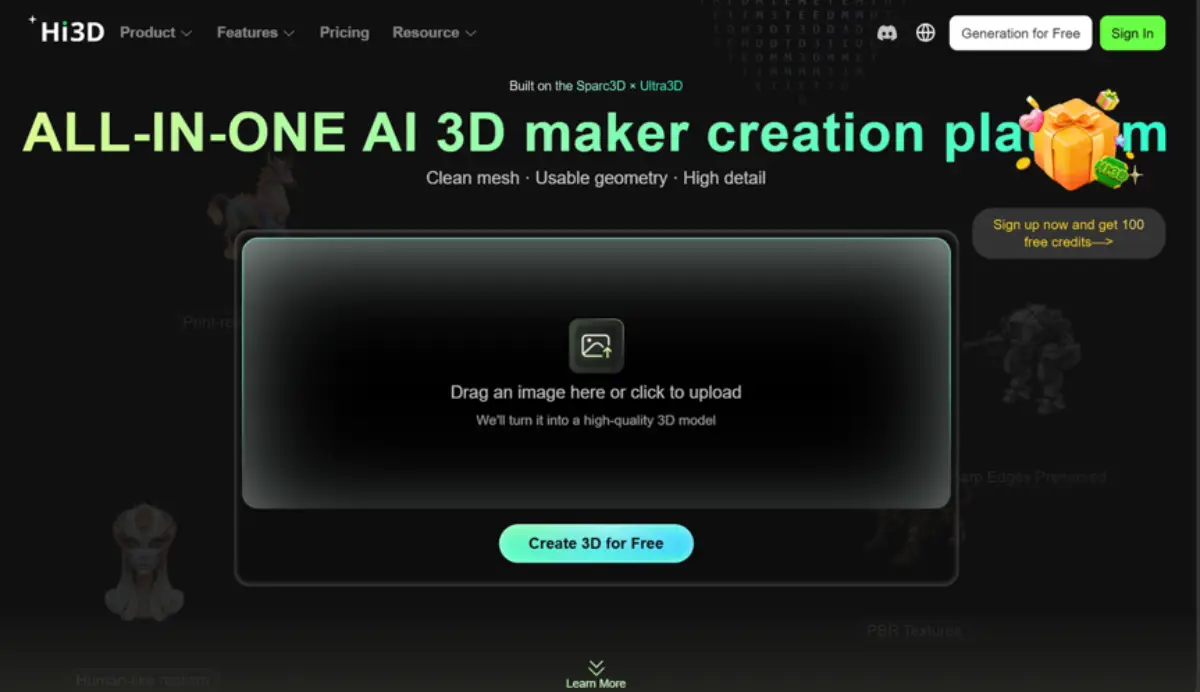
1. AI 3D Creation Is Becoming More Accessible with Hi3D
AI and 3D printing are gradually changing the way people create and produce objects. From personalized models and creative collectibles to product prototypes and educational projects, 3D printing is becoming an important tool that connects digital ideas with physical reality.
However, creating a complete 3D model is still challenging for many users. Traditional modeling requires professional skills, while AI-generated models often need additional improvements before they can be used for real production.
Hi3D provides a more efficient solution by combining AI generation technology with practical 3D workflows. It helps users transform images, text concepts, and creative ideas into 3D models while reducing the technical barriers of traditional creation.
With the official release of Hi3D V3.0, the platform takes another important step forward. The new version focuses on improving model accuracy, texture quality, and production usability, helping AI-generated models move closer to real-world applications.
For creators, designers, and 3D printing enthusiasts, Hi3D V3.0 is not only a tool for generating models faster, but also a complete AI 3D workflow designed to help ideas become usable digital and physical assets.
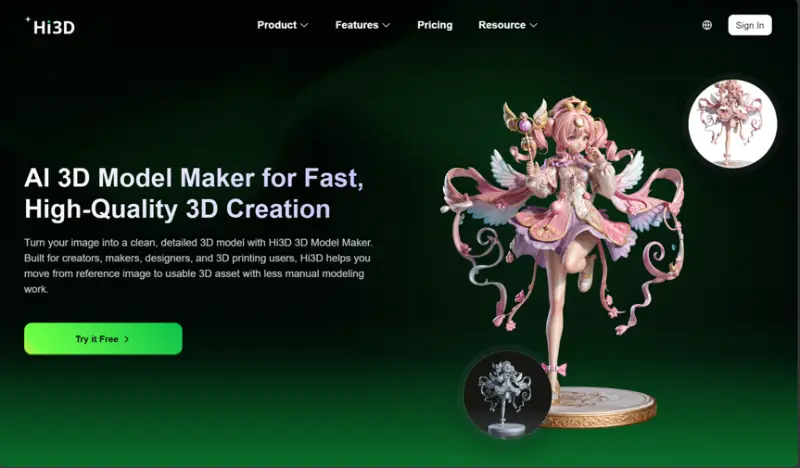
2. Image and Text to 3D Model: Making Creative Ideas Easier to Build
One of the biggest challenges in 3D creation is turning an idea into a complete model. Many users have creative concepts but lack professional modeling experience, making it difficult to quickly create 3D assets.
Hi3D simplifies this process by allowing users to start from images or text descriptions and generate models with AI assistance.
2.1 Creating 3D models from images
Images are often the first step to a creative project. A concept drawing, product image, character illustration, or personal design can represent the foundation of a future 3D object.
Instead of manually rebuilding these designs, Hi3D allows users to transform visual references into 3D models.
This capability, known as 2D to 3D image converter, helps bridge the gap between two-dimensional concepts and three-dimensional creation.
For beginners, this reduces the difficulty of entering 3D design. For experienced creators, it provides a faster way to explore concepts and test different ideas.
2.2 Generating models from text descriptions
Creative ideas do not always begin with an image. Sometimes users only have a description of an object, character, or product concept.
Hi3D supports text-based 3D generation, allowing users to describe their ideas and create models directly from imagination.
This makes AI 3D creation more flexible and helps users focus on creativity instead of complex modeling operations.
As a 3D printer model maker, Hi3D provides a more convenient approach for users who want to create printable models from simple ideas.
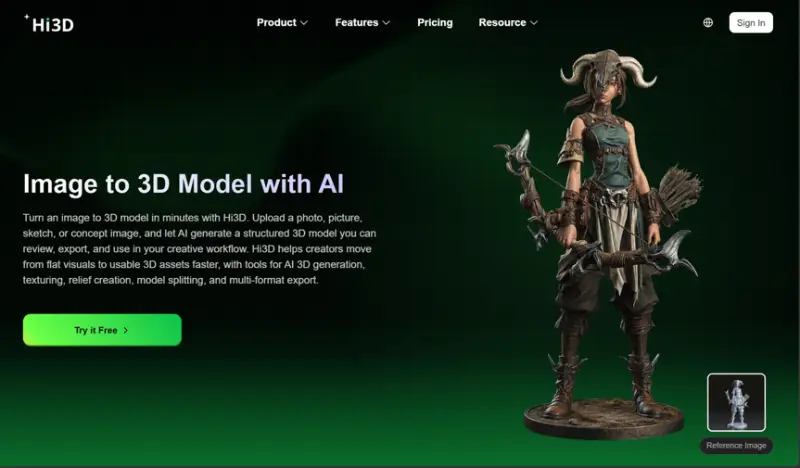
3. AI Texture Generation: Adding More Details and Visual Identity
A high-quality 3D model requires more than accurate geometry. Surface details, colors, and materials strongly influence how a model looks and how realistic it feels.
For many creators, texturing is one of the most time-consuming stages because it requires additional knowledge of materials, UV mapping, and manual adjustments.
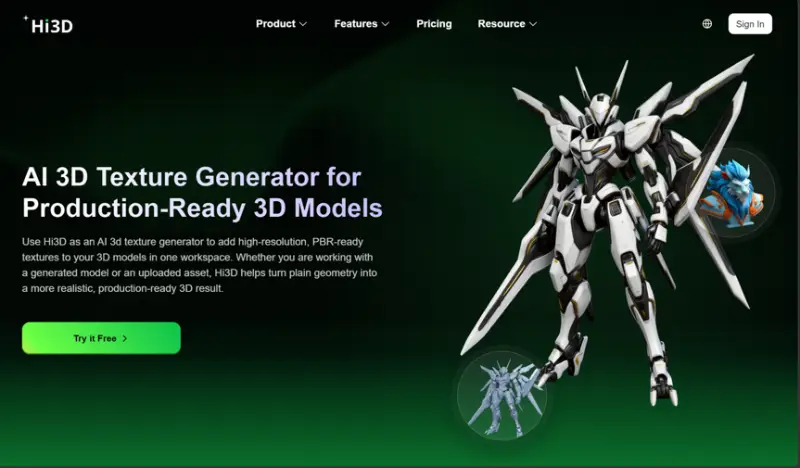
Hi3D improves this process through AI-powered texture generation.
3.1 Creating detailed textures with AI assistance
Traditional texturing workflows often require professional software and extensive experience. This can slow down the creative process, especially for beginners.
Hi3D helps simplify texture creation by allowing AI to assist with surface details and visual improvements.
This function can be described as an AI 3D texture generator, helping users create richer and more complete 3D models with less manual effort.
3.2 Improving texture quality with advanced generation technology
Hi3D V3.0 introduces significant improvements in texture generation. The new version increases texture output capability to a maximum of 8K and upgrades the self-developed UV completion algorithm.
These improvements enhance pattern clarity, color transitions, and detailed texture recognition, allowing models to maintain stronger visual quality.
For digital artists, collectible creators, and product designers, improved textures make AI-generated models more suitable for professional applications.
4. Printing Preparation Features: Helping Models Move into Physical Production
Generating a model is only one stage of the complete 3D workflow. To help users transform digital assets into printed objects, Hi3D also provides several practical preparation features.
4.1 Multi-color printing for more expressive models
Hi3D’s multi-color printing function helps convert textured models into printable multi-color objects. It improves color region generation, filament color matching, and reduces manual adjustments before printing.
This allows creators to reproduce more visual details from digital designs in physical prints.
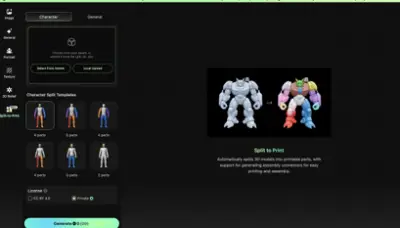
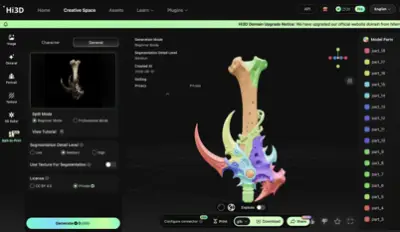
4.2 Split-for-printing and smart arrangement
For larger or more complex models, printing the entire object as one piece may not always be practical.
Hi3D provides split-for-printing capabilities that divide models into printable parts and generate connectors for easier assembly.
The smart arrangement feature helps prepare models by suggesting suitable orientations, arranging parts on the build plate, and exporting 3MF files with recommended slicer settings.
These features create a smoother connection between AI generation and real 3D printing.
5. Hi3D V3.0 Official Release: A New Era of High-Precision AI 3D Generation
The official release of Hi3D V3.0 represents a major upgrade in AI 3D technology. Instead of focusing only on faster generation, this version focuses on creating models with higher accuracy, better details, and stronger practical value.
The goal of Hi3D V3.0 is to reduce the gap between AI-generated concepts and production-ready 3D assets.
5.1 2048³ voxel-level reconstruction for higher accuracy
The most significant upgrade in Hi3D V3.0 is the improvement of geometric reconstruction capability.
The new version increases reconstruction resolution to 2048³ voxel-level and becomes the first commercially available AI 3D model with this level of resolution.
Higher reconstruction accuracy allows AI to preserve more details during the generation process, including small structures, complex connections, thin parts, and surface changes.
This improvement is important because professional applications often require models that maintain the original design intention instead of simplified shapes.
Compared with previous generation methods, Hi3D V3.0 focuses on creating models that require fewer manual corrections after generation.
6. Hi3D V3.0 Technology Upgrade: Stronger Structure Understanding and Better Details
Beyond higher resolution, Hi3D V3.0 also improves how AI understands and reconstructs complex objects.
6.1 More accurate cross-view structure reasoning
A single image only provides limited information about an object. Hidden areas, back structures, and connections require AI to understand the relationship between different views.
Hi3D V3.0 improves cross-view structure reasoning, helping generated models maintain stronger consistency from different angles.
This is especially valuable for character models, product designs, and objects with complex structures.
6.2 Better texture generation and surface details
In addition to geometry improvements, Hi3D V3.0 enhances the visual quality of generated models through upgraded texture technology.
With up to 8K texture output and improved UV completion algorithms, models can achieve clearer patterns, smoother color transitions, and richer surface information.
Together with improved geometry, these upgrades allow AI-generated models to become more complete digital assets.
7. Hi3D V3.0 Version Evolution: From AI Generation Tool to Complete Creative Workflow
Hi3D V3.0 is built on continuous improvements from previous versions. Each generation focuses on solving different challenges in AI 3D creation.
7.1 From V1.0 to V3.0: Continuous improvement of AI 3D technology
Hi3D V1.0 introduced the industry’s first commercially available 1536³ voxel-resolution image-to-3D model, improving detailed structure reconstruction.
Hi3D V2.0 focused on integrated geometry and texture generation, improving structural completion and creating a more complete AI creation workflow.
Also, Hi3D V3.0 continues this development by improving geometry precision, complex structure reasoning, texture quality, and practical features including smart splitting, multi-color printing, and arrangement tools.
The evolution of Hi3D shows a shift from simply generating models toward building a complete AI-powered 3D production ecosystem.
8. Hi3D V3.0 Industry Applications and Free Trial Experience
The value of AI 3D technology is not only reflected in model generation quality, but also in how widely it can support different industries.
8.1 Supporting different creative industries
High-quality 3D assets are becoming increasingly important in fields such as 3D printing, digital art, game and film production, jewelry design, collectibles, education, e-commerce content, and industrial design.
Although these industries have different goals, they all require reliable 3D models with accurate structures, detailed textures, and practical usability.
Hi3D V3.0 helps reduce the difficulty of creating professional-quality 3D content and allows more users to participate in AI-powered 3D production.
8.2 Experience Hi3D V3.0 with unlimited usage during the trial period
The release of Hi3D V3.0 represents a new stage for AI 3D creation. With improved reconstruction accuracy, upgraded texture generation, and stronger workflow support, Hi3D provides creators with a more complete way to transform ideas into usable models.
Hi3D V3.0 is officially released, and users can experience the new version through a 48-hour free trial. During this period, there is no limit on usage frequency, allowing users to explore the upgraded AI 3D creation experience freely.
Start exploring Hi3D V3.0 today and discover how AI can help turn creative ideas into detailed, printable, and production-ready 3D models.